

It’s been over a month since Legal Aid’s last update. After a period of relative quiet, here’s the latest from Kevin De Liban on the ARChoices program. Please note the upcoming legislative committee hearings listed below on 9/13 and 9/18.
(1) Public comments. In July, many people showed up to the public hearings or wrote DHS with comments. Those comments are attached to this email. Though the comments were overwhelmingly against the algorithm, DHS plans to go ahead and start using the RUGs algorithm again in the exact same way as they did before starting on 10/1/18.
RUGs changed the effective limit of attendant care from 8 hours per day to 5.5 or 6. This has not been enough for Legal Aid’s clients. On top of that, the algorithm is nearly impossible to understand, has had multiple software errors, and doesn’t take into account a doctor’s opinion or consider the actual amount of time it takes to provide care to someone on the program.
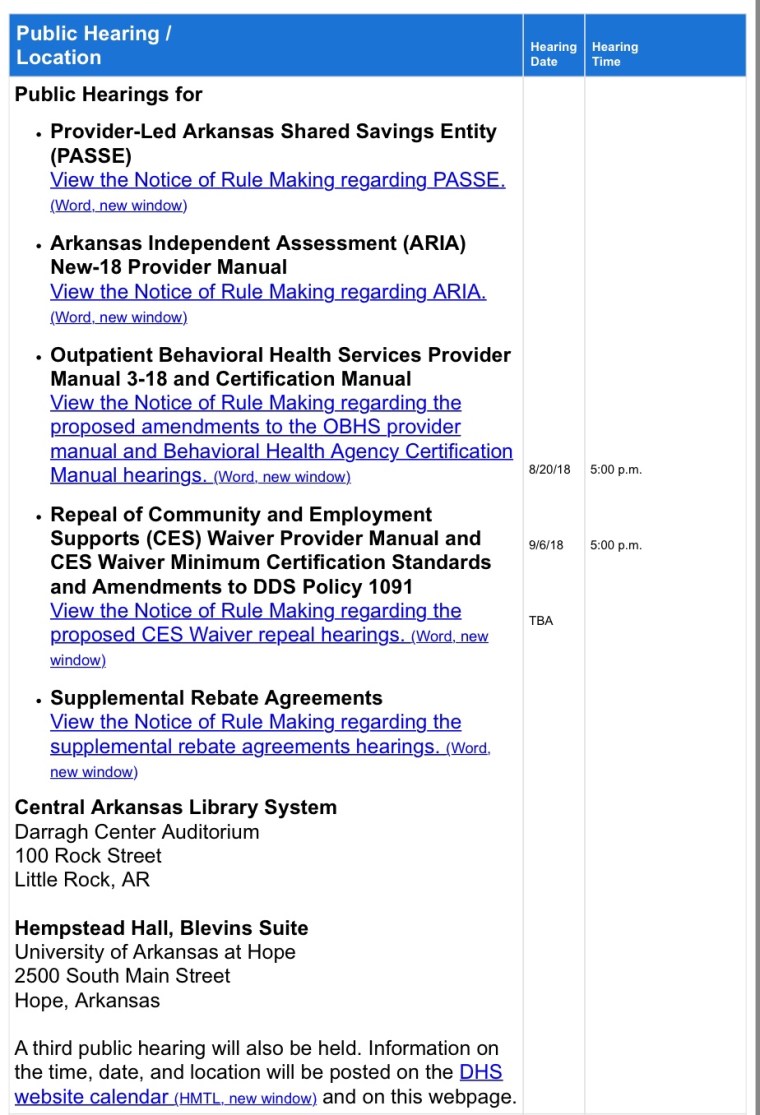
(2) The legislature is considering the RUGs algorithm this Thursday, 9/13, and next Tuesday, 9/18. DHS is presenting the algorithm to two separate legislative committees in the next week. Apparently, if the Public Health Committee does not approve it, the algorithm may be delayed or stopped.
Thursday, 9/13, 10 a.m., Public Health Committee, Room A of the MAC Building. I have been told that public comment will be accepted. People who attend must sign in on a sheet to request to speak.
Tuesday, 9/18, 1 p.m., Rules and Regulations Subcommittee, Room A of the MAC Building. I have been told that public comment will be accepted. People who attend must sign in on a sheet to request to speak.
It is not clear that the legislators on these committees will have seen the comments that were submitted to DHS. So, they may not know that most people are against the algorithm. The legislators may not have any source of information other than what DHS tells them. The meetings are open to the public, and I have been told that public comment will be accepted.
(3) DHS resumed assessments, but only for personal care (not attendant care). People already on the program still cannot get adjustments to their attendant care hours. People who’ve applied for the program are unable to get any attendant care at all. But, after we filed our ongoing lawsuit on behalf of an ARChoices applicant who was denied all services, DHS started determining applicants’ program eligibility and giving them up to 14.5 hours per week of personal care (NOT attendant care, which is slightly different). This isn’t anywhere near enough for many applicants. The lawsuit is continuing and seeks to force DHS to use the prior system of nurse discretion to allocate attendant care until a new valid method is in place.
(4) New Algorithm. As far as we know, DHS is still planning to switch to a new algorithm and new assessment system for ARChoices. This will be based on the same assessment system that is currently in use for personal care, behavioral health, and the development delay waiver. DHS has not provided a timeline for the new algorithm, but, based on the legal timelines required, the new algorithm is not likely to be put into place before 2019.
As always, if you have any questions, please feel free to write me here or call me at my office (800-967-9224 x 2206).
Contact:
Kevin De Liban, Attorney
Economic Justice Practice Group Leader
Legal Aid of Arkansas–West Memphis
310 Mid-Continent Plaza, Suite 420
West Memphis, AR 72301
Phone: (870) 732-6370 x. 2206











 Medicaid Saves Lives