
Why reinvent the wheel? ASAN already has this great resource to help you understand Medicaid, no matter which state you live in.

Why reinvent the wheel? ASAN already has this great resource to help you understand Medicaid, no matter which state you live in.
The Disability community is calling far and wide for people to take action against H.R. 620, saying that it is a bill that “fundamentally weakens the protections of the American with Disabilities Act.” Here are some resources to help you determine if it affects you or someone you love, as well as resources to help you to take action!

A link originally shared by Disability Rights Arkansas gives these tips:
“Please contact your House Representative(and others from your state) and encourage them to stay strong in their opposition to H.R.620 and any “notice and cure” bill, as a rollback of civil rights. SAVE THE ADA!
“Hello, my name is [your name]. I’m a constituent from [your state], zip code [your zip code]. I am opposed to H.R. 620 and any change to the equal access protections of the Americans with Disabilities Act. I strongly encourage Representative [add last name] to oppose any reform efforts. Thank you.”
DHS recently hosted a FB live about the PASSE to answer our questions, but some of your questions were not answered at that time. The images below show DHS’s follow-up answers to some of the questions.
For those of you who would like to go back and watch the Facebook live video from January 19, click here.


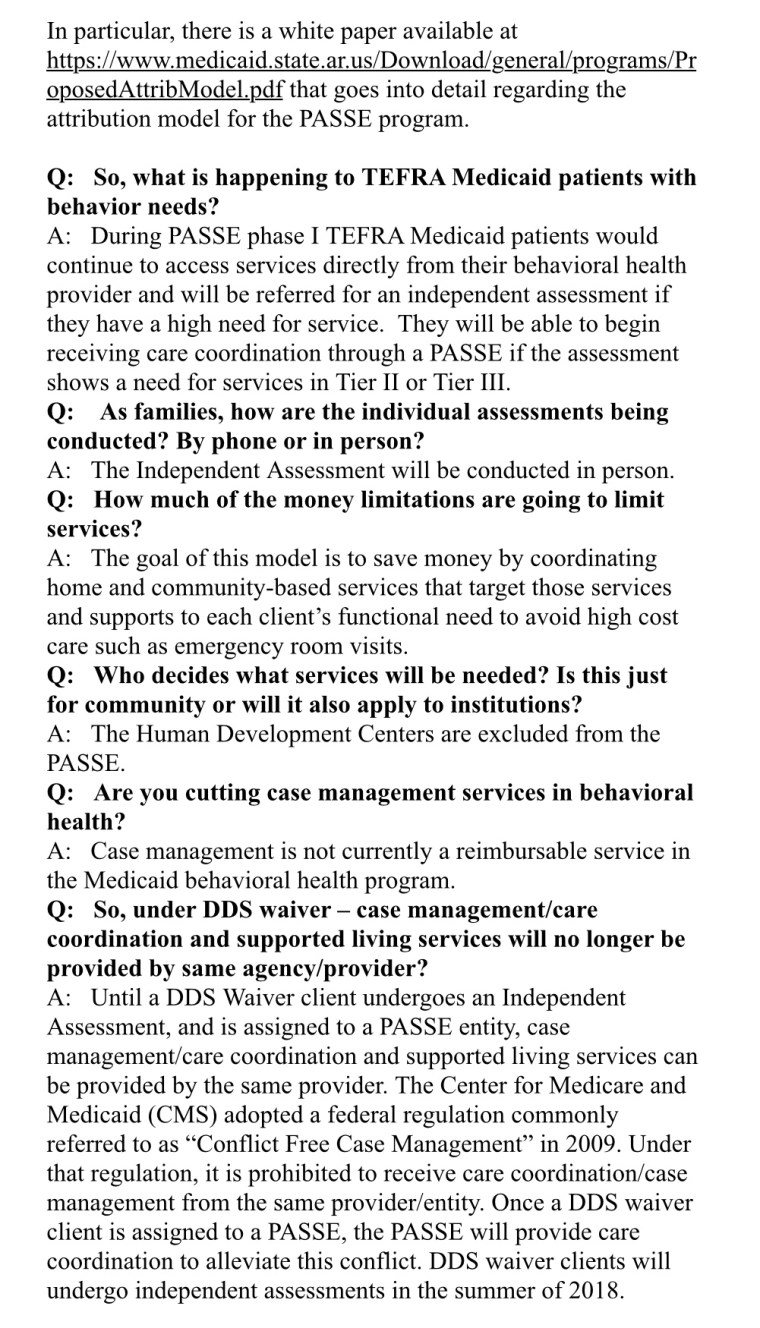
MSL took your questions to DHS, and they answered live on Facebook. This video has several good demonstrations and answers that you might need to see. The PASSEs will start taking clients in February 2018.
Watch the video:

Updated 1/3/18 09:30

We requested information on the change, and this was DHS’ response:
The Arkansas Department of Human Services is changing its dental program. Beginning January 1, 2018, two companies will provide dental coverage for families enrolled in Medicaid. Those companies are:
- Delta Dental of Arkansas
- Managed Care of North America (MCNA)
There will be no changes to the dental services that are covered. Families will be assigned to one of the two companies in December 2017 and will get new dental cards and a welcome packet in the mail for each enrolled family member.
If members want to switch to the other company, they will have 90 days to do so.
Families can begin scheduling appointments for covered dental services after January 1, 2018. Information about what is covered will be in the welcome packet.
Clients living in Human Development Centers, individuals enrolled in the Program for All Inclusive Care for the Elderly (PACE), and individuals who are eligible for Medicaid only after incurring medical expenses that cause them to “spend down” to Medicaid eligibility levels will not be enrolled in a dental plan.It is important to note that as new beneficiaries apply for Arkansas Medicaid benefits, if they qualify for dental benefits, it will take between 15 and 45 days for them to be assigned to a plan and for the plan to complete the enrollment process.
Then we requested information on the difference between the companies, and this is what DHS said about the new dental plans:
The benefits are identical and the number of dentists in each network is very close to the same (within 1%). The only real difference I can recommend is for the client to check to see if their preferred dentist is in the network to which they were assigned. If confirmed, I suggest they stay with that plan. If not, they should check with the other option to see if their preferred dentist is in that network and they will have until the end of March to change plans if they want to.
Both companies are very good at what they do and have been excellent partners for us to work with.
We also asked DHS to address the rumor that ACH Dentists won’t be covered:
Delta Dental AR has 12 of 17 dental providers at ACH credentialed and in the network. The other five have submitted their applications and are undergoing the credentialing process with the expectation that they will also be admitted to the Delta network. They added that MCNA has also had a meeting with ACH, so we can hopefully expect them to cover ACH dentists as well.
After the new year, DHS sent us more clarifying information on the providers who are included:
[We want to] share the details below to demonstrate how very close the dental provider counts are between the two managed dental care organizations now serving Medicaid clients. MCNA received slightly fewer enrollees due to assignments happening by family (keeping family members in the same plan) but the total number of providers in each network varied by 1 last month. Both companies are continuing to enroll providers including ACH.On 12/15/17 (the last phase of the auto assignment period) a total of 610,945 beneficiaries were assigned to our two dental managed care companies as follows:
- MCNA – 304,789
- Delta Dental of Arkansas – 306,156
As you know, there will be some movement as beneficiaries work through their 90 day choice period.
As of 12/20/17 the two MCO’s have contracted with, or have contracts pending for the following number of dental providers:
- MCNA
- Contracts complete – 646
- Contracts pending – 60
- 706 Dental Providers
- Delta Dental of Arkansas
- Contracts complete – 673
- Contracts pending – 34
- 707 Dental Providers
Watch the video above to get all of the contact information to get contact information and tips.
Other helpful links:
https://www.npr.org/templates/event/embeddedVideo.php?storyId=567758536&mediaId=567762951

It’s customary this time of year to count our blessings, and there’s one in particular that millions of Americans shouldn’t forget: Medicaid.
If you’re a recipient (or know a recipient), think for a second what your life would be like without Medicaid.
My little girl qualifies for TEFRA because of her diagnosis, and she’s thriving because Medicaid gives her treatments like therapy and medicines that we simply can’t afford. Medicaid not only helps her day-to-day, but it’s also giving her a future where she may someday be able to live on her own and provide for herself. Because of Medicaid, she can climb stairs, say that she wants a drink, draw a line, feed herself with a spoon, and sit quietly with other students around a table. When I think of life without Medicaid, I see many who would be crushed under personal debt and suffering without hope.
If you’re thankful for Medicaid, please tell those who make our state and national policies, especially if you need to continue receiving it.
This is the perfect time of year to let our lawmakers know that we’re thankful for Medicaid. Why? Because it’s improving and even saving lives! I ask you to take a moment, and write your elected officials a note. Even better, include a photo. Tell them why Medicaid is important to you. If writing several is overwhelming, just start with one.
You can also post on social media about why Medicaid is important to you using the hashtag #thankful4Medicaid to help others see why Medicaid is so important.
We need to tell everyone the great things that Medicaid does and who it helps. People need to hear this positive message. By sending notes, calling, and posting on social media, we are clearly communicating that we still need Medicaid, and we’re directly asking the people in charge to continue funding Medicaid for us.
Let’s flood our government with letters and calls this holiday season!
Arkansas Only
Contact any elected official in the US!
 MSL was live on FB to give some news on the Assessments and Screeners being implemented by DHS.
The Developmental Screen and Independent Assessments are different. The Developmental Screen is for children who are being referred to a developmental preschool or day habilitation center known as a DDTCS or CHMS (such as Easter Seals, Peds Plus, Access, or Friendship). The doctor would send out the referral, and this Screen would be done by a third-party to determine the eligibility for this type of center. This assessment should be fairly short, less than an hour. This Screener is set to begin on December 1, 2017 for certain centers and then expand out to the entire state by February 1, 2018.
Your Primary Care Physician should have received training on the new Developmental Screen, but if they don’t know about it, you can give them this training that DHS has already distributed. https://afmc.org/wp-content/uploads/2017/09/PROREL_Webinar_BehavioralHealth_and_DevelopmentalDisabilities_20170908.pdf
Independent Assessments are much longer Assessments that will be given to specific people who fall under Tier 2 and 3 need level of both Behavioral Health Services and Developmental Disability Services.
These Assessments have already begun, and when yours is scheduled, you should first receive a letter.
To get more information, tips, and even the full list of questions on the Independent Assessments, check out this recent post: https://medicaidsaveslives.com/2017/11/17/independent-assessment-be-prepared/

Every single person who is a Tier 2 or Tier 3 and receives Medicaid services for a Developmental disability or a Behavioral health issue will undergo an Independent Assessment. This means you need to understand what it is and what will happen. MSL has gathered some resources to help you be prepared:
First of all, you’re probably asking, which Tier am I in? Click the link to find out!
If you are Tier 2 or 3, you will receive a notification letter about your assessment. It may come from a company you don’t recognize, but make sure to look for a letter and read carefully for the words Independent Assessment. Once you receive a letter, you will soon receive a phone call to schedule a meeting.
You are allowed to take people with you in these assessments, such as a parent or provider. The assessment itself can take from one hour to three hours. It is critical carefully consider and answer the questions because they determine your Tier placement.
Once your assessment is finished, you will have to wait to receive results. Once they are compiled, both you and your primary provider will receive a copy.
DHS has released the following resources to assist you or a loved one in preparation for these Independent Assessments. MSL has gathered it all in one place for you:
The two power point presentations may be of help what is taking place within the DD service system. Additional information may also be found at the following website https://www.medicaid.state.ar.us/general/programs/passe.aspx.
The Full Independent Assessment people will get:
Presentation for Individuals, Families, and Staff:

Presentation for Providers:

Training that was sent to all PCPs:
Previous related MSL posts:
Independent Assessment Manuals
Certain people who receive Medicaid through Developmental Disability Services and/or Behavioral Health Services will be contacted about an Independent Assessment – only Tiers 2 and 3. Read the following situations to decide where you might fit:
Tier 1:
Individual receives DD services under the Medicaid State Plan (DDTCS, CHMS, therapy, etc.), but does not meet ICF/IID level of care eligibility
Tier 2:
Individual meets ICF/IID level of care eligibility, but does not currently require 24 hours/day of paid support and services to maintain his or her current placement
Tier 3:
Individual meets ICF/IID level of care eligibility and does require 24 hours/day of paid support and services to maintain his or her current placement
Tier 1: Counseling
Time-limited services provided by a qualified licensed practitioner in an outpatient setting to assess and treat mental health and/or substance abuse conditions
Tier 2: Rehabilitative
Home and community-based services with care coordination including a full array of professional and para- professional services for individuals with higher needs. Services provided by certified behavioral health agency staff members.
Tier 3: Residential
Services provided in residential setting for individuals with the highest need

 Medicaid Saves Lives