Managed Care Data provided by the Stephen Group

This data has been provided by the Stephen Group. They did this research when they recommended to Governor Hutchinson that Managed Care is a viable option for cost savings. This is being seriously considered by the legislature, and it is separate from the therapy cap that is passing through committees right now.

Before we know how to respond, we need to look at data on all sides of this issue. Please read this before you respond to your Representatives. But please know that these decisions are in work NOW. They have these facts that they believe support Managed Care. If you disagree, you will need facts as well. I hope to provide information against managed care as well to give a rounded view of the issue.

I have been given permission by the Stephen Group to share these files, and they have said that they welcome any of our questions.

2016-miliman-report-on-risk-based-managed-care

tsg-summary-of-managed-care-plans-survey-responses-for-task-force-9-2016

sellers_dorsey_medicaid_managed_care_tx

medicaid-101-mahp

mcare-101

exerpts-from-nov-15-tf-meeting-ppt-tsg

Medicaid Meeting Report – 11/29/16

Article by Kimberly Hines, MSL Leadership Team

The meeting today talked about Medicaid expenditures for both the special needs and behavioral health (BH) populations. 2016 costs for both populations were discussed and projected costs were estimated, both with and without the implementation of managed care. Please note that “halo costs” are described as costs that are above and beyond regular care, such as additional hospital admissions or ER visits. Tier III care is defined as inpatient treatment requiring 24/7 care (these are the Medicaid users that are the most expensive).
The possibility of combining both the special needs and BH populations into one managed care program was the main discussion today.

This concerns me on so many different levels. First and foremost, these two populations of patients are entirely different and should not fit under one umbrella. While the pediatric special needs population (generally speaking) have caregivers/parents to make sure they get the health care and therapy services they need, the BH population is entirely different. From a population health management standpoint, increased BH costs are commonly a result of non-compliance with medications (whether that be an inability to afford medications or a patient opting not to take them). Non-compliance can sometimes lead to an acute inpatient admission or decline in health status due to other underlying health conditions that are not managed by the patient. Another issue many BH patients experience is the lack of care access – there simply are not enough health providers for BH services. BH providers are very limited and are more apt to accept a private commercial insurance. Those BH providers that do have open Medicaid slots for new patients sometimes have a six-month waiting list. Another reason for this lack of access to adult BH care providers is due to the cost difference that Medicaid pays to providers. Medicaid reimburses physicians/providers much more substantially for the pediatric population, opposed to the adult population.

I did try to ask Dennis (the presenter) why they wanted to combine the two populations into one managed care program since the two are so different. The response I received was that this was just a preliminary planning stage and nothing was set in stone.

I also asked if they had made any cost projections that indicated how much more tier III patients with a special needs would cost them long-term if they were to decrease therapy services for special needs children now, while they are at their most rapid level of development. Dennis said they had not completed these types of projections.

I think the important thing we need to advocate for is making sure that these two populations are considered SEPARATELY. I will say that above all managed care for the BH population due to lack of access and other issues I mentioned may benefit these patients. That being said, I do not feel managed care would at all help the special needs pediatric population when you look at the reduction of therapy services to cover the costs of managed care.


If you would like to contact your representative about this, you can find more information here.

Join the movement: #thankfulformedicaid

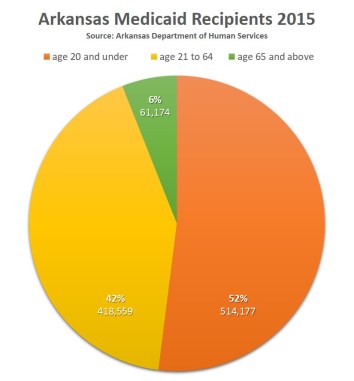
When we’re fighting for ourselves or our loved ones, we often forget that Medicaid is a 2015_recipient_chartblessing, not necessarily a right. First of all, we’re lucky to be Americans, and if you qualify for aid, you’re even more privileged. In other countries, children and adults often die of starvation or lack of medical treatment.

Life is far from easy for my family or yours. However, many Arkansans simply don’t have a diagnosis that qualifies them for financial aid at all. Recently, in a Public Health & Welfare Joint committee meeting, Representative Sullivan said that he has constituents who are concerned that their taxes are paying for children on Medicaid to receive better care than their own children, who are covered only by private insurance. Many children who don’t receive Medicaid also have a great need for therapy and expensive medical treatments.

When we lived in a neighboring state, under Managed Care I might add, we had to live solely on what private insurance covered. Our deductible was very high, and some therapies like Speech were not even covered. Treating my daughter’s heart condition alone, we had usually met the threshold by April. But we had no choice because without the treatment, she would die. With both of us working, we still couldn’t cover the costs. The lack of some treatments, the ones we just could not afford, has left her profoundly delayed. After that experience, I realize what other Arkansans are suffering through.

Of course, many feel at least a slight entitlement to this aid. My first response was to feel defensive at Rep. Sullivan’s statement. In my case, I have paid taxes for years. For 8 years, I paid taxes to improve schools, even though I was not a student or parent. I have probably paid for countless parks or road repair that I have yet to see. For 17 years, before it ever benefited anyone I knew, I paid taxes that funded Medicaid. Why should I feel guilty about receiving it now? In fact, even as a Medicaid recipient, I pay a lot for the care my daughter gets – first for a private insurance premium and second a TEFRA premium. Why shouldn’t I fight for my child’s needs?

Those thoughts are the trap of a selfish heart. The beauty of taxes in our country is that they are a way that we can take care of each other’s needs. As American citizens, we do get to express our opinions about how best to apply those funds. Our country is full of worthy causes, and there’s only so much money to go around. Yes, my job is to speak up for my loved one, but I need to do so with a thankful and empathetic heart.

budget

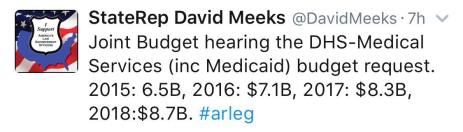
At the Legislative Joint Budget hearing yesterday, it was reported that the DHS Medical Services budget is growing. Cuts to therapy will be implemented, and yet the number is rising year after year. From our side, we know it’s worth allocating money to Medicaid. But think about how other taxpayers feel about the rising costs. People need their money to cover their own costs, and many other needs in the country beg for tax funds to cover them. That’s why we can expect more cuts. We have to think about it from their side because they’re speaking to their representatives too. Many of them don’t have a good view of Medicaid recipients. If we want to protect the funds we receive, we need to come together to THANK our lawmakers and fellow tax-paying Arkansans. We should tell them what great things that Medicaid does for Arkansas, but if we demand it, they may be more apt to cut the budget. Taxpayers are literally saving lives by going to work every day and by paying taxes that fund Medicaid. How will they know that if we don’t tell them?

Many of us still hold some fear about the therapy cap issue and the possibility of managed care. Today, I spoke to Representative Sullivan by phone about how best to improve this situation for everyone. I was encouraged to know that he is a former teacher and principal, and currently he’s the CEO of Ascent Child Health Services. That means he has daily experience with what great things Medicaid can do, and he understands the intricacies of the system. He is a person who seems to “see the real people behind the billing codes.” Rep. Sullivan said he is working with a group of legislators on ideas of where best to save money with a strategy that would be aimed at improving the quality of care and the cost of care – for those on Medicaid and for all taxpayers. He offered to meet with me, and possibly our whole group if we can work that out, to provide answers to our questions.

If you’re in need of Medicaid, that probably means that life is no picnic for you. But before you storm to the capitol to fight, take a minute to think about those who don’t get the help that you get. Stop to take a step outside yourself. What do non-recipients see when they look at us? I want them to see us as thankful. I want them to see us as people who put those dollars to good use. Take a minute to think about what Medicaid has done for you or a loved one. Be thankful, and fight hard to inspire those around you toward unity.

If you want to take action, call your Senators and Representatives, and thank them for the funding that we receive. Tell them the wonderful ways in which Medicaid affects your life. If you’re on social media, take a second to thank those around you. Tell them what lifesavers they are! #thankfulformedicaid

Large Therapy Workgroup – 11/18/16

The next meeting of the Therapy Workgroup will be on Friday, November 18, 2016 from 12:00 pm – 2:00 pm.

The location of the meeting is:
Easter Seals Arkansas
3724 Woodland Heights Road
Little Rock, AR 72212

You may also join through the Zoom conference platform utilizing the following:

Topic: Large Group Pediatric Healthcare Alliance Meeting
Time: Nov 18, 2016 12:00 PM (GMT-6:00) Central Time (US and Canada)

Join from PC, Mac, Linux, iOS or Android: https://zoom.us/j/636793728?pwd=LLDmDq9a1wc%3D
Password: Friday

Or iPhone one-tap (US Toll): +14086380968,636793728# or +16465588656,636793728#

Or Telephone:
Dial: +1 408 638 0968 (US Toll) or +1 646 558 8656 (US Toll)
Meeting ID: 636 793 728
International numbers available: https://zoom.us/zoomconference?m=_V-wKP6O5d5C_lq0iW5gKi3m8C4HGNk4

Please forward Stephanie any documents that you wish to share and discuss at the meeting. Stephanie will send out an agenda and any attachments on Thursday, 11/17/2016.

ssmith@eastersealsar.com

Get serious!

Ok, everybody. It’s time to get serious. If you care about Medicaid coverage, you need to get on board.

https://medicaidsaveslives.com/what-you-can-do/leadership-team-application/

It doesn’t cost that much time and effort to fight for something we need so desperately.

President-elect Trump has detailed his plan for the first 100 days, and tax cuts sound good, don’t they? Those tax cuts will affect us. The money will come from somewhere! Tax cuts are already affecting us. Our group can make a difference if we stand together as one voice. If we take action instead of sitting passively. We have to tell our leaders that this funding is essential for Arkansas families! Work with me!

Click to access O-TRU-102316-Contractv02.pdf

Behavioral Health Services – Rules open for Public Comment

There are a couple of rules open for public comment until November 13, 2016.


Several manuals will change in this rule change proposal. Here are the important changes:

All of these documents can be found in full here.

Please send your comments to robert.nix@dhs.arkansas.gov.


LMHP-2-16 Provider Manual Update
The transition process to eliminate the Rehabilitative Services for Persons with Mental Illness (RSPMI) Program, Licensed Mental Health Practitioner (LMHP) Program and the Substance Abuse Treatment Services (SATS) Program is contingent upon the approval of the implementation of the Outpatient Behavioral Health Services Program.  Clients currently served by the RSPMI, LMHP and SATS programs will begin transitioning to the Outpatient Behavioral Health Program starting July 1, 2017.  RSPMI, LMHP and SATS will cease to exist on June 30, 2018 and no Arkansas Medicaid payments will occur to any RSPMI, LMHP or SATS provider for services provided after June 30, 2018.


INPPSYCH-3-16 Provider Manual Update

203.100             Facility-Based Community Reintegration Program 7-1-17

The Facility-Based Community Reintegration Program is designed to serve as an intermediate level of care between inpatient psychiatric facilities and outpatient services.  To enroll as a freestanding Facility-Based Community Reintegration Program unit or as a Facility-Based Community Reintegration Program unit within an inpatient psychiatric hospital, the inpatient psychiatric provider must meet all of the conditions listed below:

  1. The provider must meet the child and adolescent standards of the Joint Commission on Accreditation of Healthcare Organizations (JCAHO) and be accredited by JCAHO.
  2. Any provider located within Arkansas must be licensed by the Arkansas Department of Human Services as a Facility-Based Community Reintegration Program.

This manual, the Inpatient Psychiatric Services for Under Age 21 Provider Manual, shall govern all aspects of services provided as well as claim submissions for beneficiaries of the Facility-Based Community Reintegration Program.

211.000             Scope 7-1-17

G.     Under the direction of a physician (contracted physicians are acceptable).

A standardized independent assessment will determine eligibility for Inpatient Psychiatric Services for Persons Under Age 21.  The standardized independent assessment must be performed by an independent entity.

The independent assessment will contain additional criteria and questions, which will be asked based upon results from the independent assessment to determine eligibility for Inpatient Psychiatric Services for Persons Under Age 21.  Acute inpatient psychiatric care will not require an independent assessment.

The standardized independent assessment must be conducted at least every 12 months by an independent assessor in consultation with the beneficiary and anyone the beneficiary requests to participate in the standardized independent assessment.  The standardized independent assessment will also take into consideration information obtained from behavioral health service providers that are providing services to the beneficiary.

A beneficiary must be referred to the independent assessment entity to evaluate whether the beneficiary meets the eligibility criteria for Inpatient Psychiatric Services for Persons Under Age 21.  The following are allowable methods of referral to receive a standardized independent assessment for determination of eligibility for Inpatient Psychiatric Services for Persons Under Age 21:

A.      Trigger from claims data/MMIS claims data

B.      Referral from counseling level services provider

C.      Referral from physician (including those in acute settings, mobile crisis units)

D.      An individual determined to be medically fragile due to behavior health needs

E.      Referral from the Division of Children and Family Services (DCFS)/the Division of Youth Services (DYS) when they are the legal guardian of the beneficiary

F.      Referral/court order from the court system/justice system

G.     Referral from care coordination entity

A re-assessment can be requested by the direct behavioral health service provider or the care coordination entity if the direct behavioral health service provider or care coordination entity determines the beneficiary’s needs are not being met or the beneficiary is not benefitting from the Inpatient Psychiatric Services for Persons Under Age 21 being provided.

The independent assessor will contact the beneficiary to be assessed within 48 hours of referral and will complete the face-to-face assessment within 14 calendar days.  For identified priority populations, the independent assessor will contact the beneficiary to be assessed within 24 hours of notification from the beneficiary’s provider and will complete the assessment within 7 days of the notification.  Examples of priority population include, but are not to be limited to:

A.      Youth involved in the juvenile justice system

B.      Individuals involved in the foster care system

C.      Individuals discharged from acute hospital stays

D.      Individuals discharged from crisis residential stays

E.      Adults involved in the criminal justice system

F.      Clients identified and referred by the Division of Behavioral Health Services (DBHS)

250.500             Facility-Based Community Reintegration Program 7-1-17

The per diem rates for Facility-Based Community Reintegration Programs are established at the lesser of: 1) the center’s budgeted cost per day which includes the professional component or 2) a $245 per day upper limit (cap).  This is a prospective rate with no cost settlement.

The budgeted per diem cost is calculated from the annual budget, which all Facility-Based Community Reintegration Program providers are required to submit for the upcoming state fiscal year (July 1st through June 30th).  Annual budgets are due by April 30th.  Should April 30th fall on a Saturday, Sunday or state or federal holiday, the due date shall be the following business day.  Failure to submit the budget by April 30th may result in the suspension of reimbursement until the budget is submitted.  Rates are calculated annually and are effective for dates of service occurring during the state fiscal year for which the budgets have been prepared.

New providers are required to submit a full year’s annual budget for the current state fiscal year (July 1st through June 30th) at the time of enrollment.  This budget is used to set their rate at the lesser of the budgeted allowable cost per day or the upper limit (cap) of $245 per day.


RSPMI-4-16 Provider Manual Update
The transition process to eliminate the Rehabilitative Services for Persons with Mental Illness (RSPMI) Program, Licensed Mental Health Practitioner (LMHP) Program and the Substance Abuse Treatment Services (SATS) Program is contingent upon the approval of the implementation of the Outpatient Behavioral Health Services Program.
  Clients currently served by the RSPMI, LMHP and SATS programs will begin transitioning to the Outpatient Behavioral Health Program starting July 1, 2017.  RSPMI, LMHP and SATS will cease to exist on June 30, 2018 and no Arkansas Medicaid payments will occur to any RSPMI, LMHP or SATS provider for services provided after June 30, 2018.


SATS-2-16 Provider Manual Update
The transition process to eliminate the Rehabilitative Services for Persons with Mental Illness (RSPMI) Program, Licensed Mental Health Practitioner (LMHP) Program and the Substance Abuse Treatment Services (SATS) Program is contingent upon the approval of the implementation of the Outpatient Behavioral Health Services Program.
  Clients currently served by the RSPMI, LMHP and SATS programs will begin transitioning to the Outpatient Behavioral Health Program starting July 1, 2017.  RSPMI, LMHP and SATS will cease to exist on June 30, 2018 and no Arkansas Medicaid payments will occur to any RSPMI, LMHP or SATS provider for services provided after June 30, 2018.


SBMH-1-16 Provider Manual Update
* There are several smaller changes in this manual that deserve notice, but here’s the biggest.

211.300             Primary Care Physician (PCP) Referral 7-1-17

Each beneficiary who receives School-Based Mental Health Services can receive a limited amount of services.  Once those limits are reached, a Primary Care Physician (PCP) referral or Patient-Centered Medical Home (PCMH) approval will be necessary to continue treatment.  This referral or approval must be retained in the beneficiary’s medical record.

A beneficiary can receive three (3) School-Based Mental Health Services before a PCP/PCMH referral is necessary.  No services will be allowed to be provided without appropriate PCP/PCMH referral.  The PCP/PCMH referral must be kept in the beneficiary’s medical record.

The Patient-Centered Medical Home (PCMH) will be responsible for coordinating care with a beneficiary’s PCP or physician for School-Based Mental Health Services.  Medical responsibility for beneficiaries receiving School-Based Mental Health Services shall be vested in a physician licensed in Arkansas.

The PCP referral or PCMH authorization for School-Based Mental Health Services will serve as the prescription for those services.

See Section I of this manual for the PCP procedures.  A PCP referral is generally obtained prior to providing service to Medicaid-eligible children.  However, a PCP is given the option of providing a referral after a service is provided.  If a PCP chooses to make a referral after a service has been provided, the referral must be received by the SBMH provider no later than 45 calendar days after the date of service.  The PCP has no obligation to give a retroactive referral.

214.000             Covered Services 7-1-17

Outpatient Services

Fifteen-minute units, unless otherwise stated.

Outpatient Behavioral Health Services must be billed on a per-unit basis, as reflected in a daily total, per beneficiary, per service.


One (1) unit = 8–24 minutes
Two (2) units = 25–39 minutes
Three (3) units = 40–49 minutes
Four (4) units = 50–60 minutes


Time spent providing services for a single beneficiary may be accumulated during a single, 24-hour calendar day.  Providers may accumulatively bill for a single date of service, per beneficiary, per Outpatient Behavioral Health service.  Providers are not allowed to accumulatively bill for spanning dates of service.

All billing must reflect a daily total, per Outpatient Behavioral Health service, based on the established procedure codes.  No rounding is allowed.

The sum of the days’ time, in minutes, per service will determine how many units are allowed to be billed.  That number must not be exceeded.  The total number of minutes per service must be compared to the following grid, which determines the number of units allowed.


One (1) unit = 8–24 minutes
Two (2) units = 25–39 minutes
Three (3) units = 40–49 minutes
Four (4) units = 50–60 minutes


In a single-claim transaction, a provider may bill only for service time accumulated within a single day for a single beneficiary.  There is no “carryover” of time from one day to another or from one beneficiary to another.

Documentation in the beneficiary’s record must reflect exactly how the number of units is determined.

No more than four (4) units may be billed for a single hour per beneficiary or provider of the service.

219.100             Record Reviews 7-1-17

The Division of Medical Services (DMS) of the Arkansas Department of Human Services (DHS) has contracted with an independent contractor to perform on-site inspections of care (IOC) and retrospective reviews of outpatient mental health services provided by Outpatient Behavioral Health Services providers.  View or print current contractor contact information.  The reviews are conducted by licensed mental health professionals and are based on applicable federal and state laws, rules and professionally recognized standards of care.

228.130             Retrospective Reviews 7-1-17

The Division of Medical Services (DMS) of the Arkansas Department of Human Services has contracted with a Quality Improvement Organization (QIO) or QIO-like organization to perform retrospective (post-payment) reviews of outpatient mental health services provided by Outpatient Behavioral Health providers.  View or print current contractor contact information.

The reviews will be conducted by licensed mental health professionals who will examine the medical record for compliance with federal and state laws and regulations.

228.131             Purpose of a Review 7-1-17

The purpose of a review is to:

  1. Ensure that services are delivered in accordance with the treatment plan and conform to generally accepted professional standards.
  2. Evaluate the medical necessity of services provided to Medicaid beneficiaries.
  3. Evaluate the clinical documentation to determine if it is sufficient to support the services billed during the requested period of authorized services.
  4. Safeguard the Arkansas Medicaid program against unnecessary or inappropriate use of services and excess payments in compliance with 42 CFR § 456.3(a).
229.000             Medicaid Beneficiary Appeal Process 7-1-17

If an adverse decision is received, the beneficiary may request a fair hearing of the denial decision.

The appeal request must be in writing and received by the Appeals and Hearings Section of the Department of Human Services within thirty days of the date on the letter explaining the denial of services.

229.200             Recoupment Process 7-1-17

The Division of Medical Services (DMS), Utilization Review Section (UR) is required to initiate the recoupment process for all claims that the current contractor has denied because the records submitted do not support the claim of medical necessity.

Arkansas Medicaid will send the provider an Explanation of Recoupment Notice that will include the claim date of service, Medicaid beneficiary name and ID number, service provided, amount paid by Medicaid, amount to be recouped, and the reason the recoupment is initiated.

272.110             Mental Health Diagnosis 7-1-17


CPT®/HCPCS PROCEDURE CODE PROCEDURE CODE DESCRIPTION
90791 Psychiatric diagnostic evaluation (with no medical services)
SERVICE DESCRIPTION MINIMUM DOCUMENTATION REQUIREMENTS
Mental Health Diagnosis is a clinical service for the purpose of determining the existence, type, nature and appropriate treatment of a mental illness or related disorder as described in the current allowable DSM. This service may include time spent for obtaining necessary information for diagnostic purposes. The psychodiagnostic process may include, but is not limited to, a psychosocial and medical history, diagnostic findings, and recommendations. This service must include a face-to-face component and will serve as the basis for documentation of modality and issues to be addressed (Plan of Care). Services must be congruent with the age and abilities of the beneficiary, client-centered and strength-based, with emphasis on needs as identified by the beneficiary and provided with cultural competence. ·      Date of service·      Start and stop times of the face-to-face encounter with the beneficiary and the interpretation time for diagnostic formulation·      Place of service·      Identifying information·      Referral reason·      Presenting problem(s), history of presenting problem(s) including duration, intensity and response(s) to prior treatment·      Culturally- and age-appropriate psychosocial history and assessment·      Mental status/clinical observations and impressions·      Current functioning plus strengths and needs in specified life domains·      DSM diagnostic impressions to include all axes·      Treatment recommendations·      Goals and objectives to be placed in Plan of Care·      Staff signature/credentials/date of signature
NOTES UNIT BENEFIT LIMITS
This service may be billed for face-to-face contact as well as for time spent obtaining necessary information for diagnostic purposes; however, this time may NOT be used for development or submission of required paperwork processes (i.e. treatment plans, etc.). Encounter DAILY MAXIMUM OF UNITS THAT MAY BE BILLED: 1 YEARLY MAXIMUM OF UNITS THAT MAY BE BILLED (extension of benefits can be requested): 1
APPLICABLE POPULATIONS SPECIAL BILLING INSTRUCTIONS
Children and Youth Outpatient Behavioral Health Services Providers cannot bill 90791 on same date of service
ALLOWED MODE(S) OF DELIVERY TIER
Face-to-face School-Based Mental Health
ALLOWABLE PERFORMING PROVIDER PLACE OF SERVICE
·      Licensed Certified Social Worker (LCSW)·      Licensed Master Social Worker (LMSW)·      Licensed Professional Counselor (LPC)·      Licensed Associate Counselor (LAC)·      Licensed Psychological Examiner (LPE)·      Psychologist* School-Based Mental Health Services provider employees or contractors will provide services only in those areas in which they are licensed or credentialed. 03


272.120             Psychological Evaluation 7-1-17


CPT®/HCPCS PROCEDURE CODE PROCEDURE CODE DESCRIPTION
96101 Psychological testing (includes psychodiagnostic assessment of emotionality, intellectual abilities, personality and psychopathology, e.g. MMPI, Rorschach®, WAIS®), per hour of the psychologist’s or physician’s time, both face-to-face time administering tests to the patient and time interpreting these test results and preparing the report.
SERVICE DESCRIPTION MINIMUM DOCUMENTATION REQUIREMENTS
Psychological evaluation for personality assessment includes psychodiagnostic assessment of a beneficiary’s emotional, personality, and psychopathology, e.g. MMPI, Rorschach®, and WAIS®. Psychological testing is billed per hour both face-time administering tests and time interpreting these tests and preparing the report. This service may reflect the mental abilities, aptitudes, interests, attitudes, motivation, emotional and personality characteristics of the beneficiary. Medical necessity for this service is met when:•       the service is necessary to establish a differential diagnosis of behavioral or psychiatric conditions;•       history and symptomatology are not readily attributable to a particular psychiatric diagnosis; or•       questions to be answered by the evaluation could not be resolved by a psychiatric/diagnostic interview, observation in therapy or an assessment for level of care at a mental health facility. •     Date of service•     Start and stop times of actual encounter with beneficiary•     Start and stop times of scoring, interpretation and report preparation•     Place of service•     Identifying information•     Rationale for referral•     Presenting problem(s)•     Culturally- and age-appropriate psychosocial history and assessment•     Mental status/clinical observations and impressions•     Psychological tests used, results, and interpretations, as indicated•     DSM diagnostic impressions to include all axes•     Treatment recommendations and findings related to rationale for service and guided by test results•     Staff signature/credentials/date of signature(s)
NOTES UNIT BENEFIT LIMITS
  60 minutes DAILY MAXIMUM OF UNITS THAT MAY BE BILLED: 1 YEARLY MAXIMUM OF UNITS THAT MAY BE BILLED (extension of benefits can be requested): 8
APPLICABLE POPULATIONS SPECIAL BILLING INSTRUCTIONS
Children and Youth  
ALLOWED MODE(S) OF DELIVERY TIER
Face-to-face School-Based Mental Health
ALLOWABLE PERFORMING PROVIDERS PLACE OF SERVICE
•     Licensed Psychological Examiner (LPE)•     Psychologist 03


272.130             Interpretation of Diagnosis 7-1-17


CPT®/HCPCS PROCEDURE CODE PROCEDURE CODE DESCRIPTION
90887 Interpretation or explanation of results of psychiatric or other medical examinations and procedures, or other accumulated data to family or other responsible persons, or advising them how to assist patient
SERVICE DESCRIPTION MINIMUM DOCUMENTATION REQUIREMENTS
Interpretation of Diagnosis is a direct service provided for the purpose of interpreting the results of psychiatric or other medical exams, procedures or accumulated data. Services may include diagnostic activities and/or advising the beneficiary and his/ her family. Consent forms may be required for family or significant other involvement. Services must be congruent with the age and abilities of the beneficiary, client-centered and strength-based, with emphasis on needs as identified by the beneficiary and provided with cultural competence. •     Start and stop times of face to face encounter with beneficiary and/or parents or guardian•     Date of service•     Place of service•     Participants present and relationship to beneficiary•     Diagnosis•     Rationale for and objective used that must coincide with the goals and objectives placed in Plan of Care•     Participant(s) response and feedback•     Staff signature/credentials/date of signature(s)
NOTES UNIT BENEFIT LIMITS
For beneficiaries under the age of 18, the time may be spent face-to-face with the beneficiary, the beneficiary and the parent(s) or guardian(s) or alone with the parent(s) or guardian(s). For beneficiaries over the age of 18, the time may be spent face-to-face with the beneficiary and the spouse, legal guardian or significant other. Encounter DAILY MAXIMUM OF UNITS THAT MAY BE BILLED: 1 YEARLY MAXIMUM OF UNITS THAT MAY BE BILLED (extension of benefits can be requested): 1
APPLICABLE POPULATIONS SPECIAL BILLING INSTRUCTIONS
Children and Youth  
ALLOWED MODE(S) OF DELIVERY TIER
Face-to-face School-Based Mental Health
ALLOWABLE PERFORMING PROVIDERS PLACE OF SERVICE
•     Licensed Certified Social Worker (LCSW)•     Licensed Master Social Worker (LMSW)•     Licensed Professional Counselor (LPC)•     Licensed Associate Counselor (LAC)•     Licensed Psychological Examiner (LPE)•     Psychologist* School-Based Mental Health Services provider employees or contractors will provide services only in those areas in which they are licensed or credentialed. 03


272.140             Marital/Family Behavioral Health Counseling with Beneficiary Present 7-1-17


CPT®/HCPCS PROCEDURE CODE PROCEDURE CODE DESCRIPTION
90847 Family psychotherapy with patient present (conjoint psychotherapy)
SERVICE DESCRIPTION MINIMUM DOCUMENTATION REQUIREMENTS
Marital/Family Behavioral Health Counseling with Beneficiary Present is a face-to-face treatment provided to one or more family members in the presence of a beneficiary. Services must be congruent with the age and abilities of the beneficiary, client-centered and strength-based, with emphasis on needs as identified by the beneficiary and provided with cultural competence. Services are designed to enhance insight into family interactions, facilitate inter-family emotional or practical support and to develop alternative strategies to address familial issues, problems and needs. Services pertain to a beneficiary’s (a) Mental Health and/or (b) Substance Abuse condition. Additionally, tobacco cessation counseling is a component of this service. •       Date of Service•       Start and stop times of actual encounter with beneficiary and spouse/family•       Place of service•       Participants present and relationship to beneficiary•       Diagnosis and pertinent interval history•       Brief mental status of beneficiary and observations of beneficiary with spouse/family •       Rationale for, and description of treatment used, that must coincide with the master treatment plan and improve the impact the beneficiary’s condition has on the spouse/family and/or improve marital/family interactions between the beneficiary and the spouse/family.•       Beneficiary and spouse/family’s response to treatment that includes current progress or regression and prognosis•       Any changes indicated for the master treatment plan, diagnosis, or medication(s)•       Plan for next session, including any homework assignments and/or crisis plans•       Staff signature/credentials/date of signature•       HIPAA compliant release of Information, completed, signed and dated
NOTES UNIT BENEFIT LIMITS
Natural supports may be included in these sessions if justified in service documentation.  Only one beneficiary per family per therapy session may be billed. Encounter DAILY MAXIMUM OF UNITS THAT MAY BE BILLED: 1 YEARLY MAXIMUM OF UNITS THAT MAY BE BILLED (extension of benefits can be requested): 12
APPLICABLE POPULATIONS SPECIAL BILLING INSTRUCTIONS
Children and Youth  
ALLOWED MODE(S) OF DELIVERY TIER
Face-to-face School-Based Mental Health
ALLOWABLE PERFORMING PROVIDERS PLACE OF SERVICE
•     Licensed Certified Social Worker (LCSW)•     Licensed Master Social Worker (LMSW)•     Licensed Professional Counselor (LPC)•     Licensed Associate Counselor (LAC)•     Licensed Psychological Examiner (LPE)•     Psychologist* School-Based Mental Health Services provider employees or contractors will provide services only in those areas in which they are licensed or credentialed. 03


272.150             Crisis Intervention 7-1-17


CPT®/HCPCS PROCEDURE CODE PROCEDURE CODE DESCRIPTION
H2011, HA Crisis intervention service, per 15 minutes
SERVICE DESCRIPTION MINIMUM DOCUMENTATION REQUIREMENTS
Crisis Intervention is unscheduled, immediate, short-term treatment activities provided to a Medicaid-eligible beneficiary who is experiencing a psychiatric or behavioral crisis.  Services are to be congruent with the age, strengths, needed accommodation for any disability, and cultural framework of the beneficiary and his/her family.  These services are designed to stabilize the person in crisis, prevent further deterioration and provide immediate indicated treatment in the least restrictive setting.  (These activities include evaluating a Medicaid-eligible beneficiary to determine if the need for crisis services is present.) •     Date of service•     Start and stop time of actual encounter with beneficiary and possible collateral contacts with caregivers or informed persons•     Place of service•     Specific persons providing pertinent information in relationship to beneficiary•     Diagnosis and synopsis of events leading up to crisis situation•     Brief mental status and observations•     Utilization of previously established psychiatric advance directive or crisis plan as pertinent to current situation OR rationale for crisis intervention activities utilized•     Beneficiary’s response to the intervention that includes current progress or regression and prognosis•     Clear resolution of the current crisis and/or plans for further services•     Development of a clearly defined crisis plan or revision to existing plan•     Staff signature/credentials/date of signature(s)
NOTES UNIT BENEFIT LIMITS
A psychiatric or behavioral crisis is defined as an acute situation in which an individual is experiencing a serious mental illness or emotional disturbance to the point that the beneficiary or others are at risk for imminent harm or in which to prevent significant deterioration of the beneficiary’s functioning.This service can be provided to beneficiaries that have not been previously assessed or have not previously received behavioral health services.The provider of this service MUST complete a Mental Health Diagnosis (90791) within 7 days of provision of this service.  If the beneficiary needs more time to be stabilized, this must be noted in the beneficiary’s medical record and the Division of Medical Services Quality Improvement Organization (QIO) must be notified. 15 minutes DAILY MAXIMUM OF UNITS THAT MAY BE BILLED: 12 YEARLY MAXIMUM OF UNITS THAT MAY BE BILLED (extension of benefits can be requested): 72
APPLICABLE POPULATIONS SPECIAL BILLING INSTRUCTIONS
Children and Youth  
ALLOWED MODE(S) OF DELIVERY TIER
Face-to-face School-Based Mental Health
ALLOWABLE PERFORMING PROVIDERS PLACE OF SERVICE
•     Licensed Certified Social Worker (LCSW)•     Licensed Master Social Worker (LMSW)•     Licensed Professional Counselor (LPC)•     Licensed Associate Counselor (LAC)•     Licensed Psychological Examiner (LPE)•     Psychologist* School-Based Mental Health Services provider employees or contractors will provide services only in those areas in which they are licensed or credentialed. 03


Large Therapy Workgroup Meeting – 11/4/16

If you are a therapist or provider who has not RSVP’d to the meeting, you can still join by following this link. The directions are provided below.

Online Meeting Link: https://join.freeconferencecall.com/medicaidsaveslives
Online Meeting ID: medicaidsaveslives

Large Therapy Workgroup Meeting

Friday, November 4, 2016
1:30 pm
Easter Seals Arkansas
3920 Woodland Heights Road
Little Rock, AR 72212

Tentative Agenda:

  • Update on Data and Savings Calculation
  • Draft prior authorization process and identify all critical components to address concerns
  • Draft assessment process for ages and stages screening for physician referrals to CHMS and DDTCS programs for Day Hab and identify disability diagnosis that would be exempt from this process

Please have anyone who is coming send an email to ssmith@eastersealsar.com so they can get an approximate count of how many will be in attendance.

If you are a therapist or provider who needs to attend Friday’s Large Therapy Workgroup meeting remotely, please email medicaidsaveslives@gmail.com to receive directions to access the video conference call. Make sure to RSVP by Friday at 10am.

The directions for connecting are HERE, but you still must email to receive the invitation link the day of the meeting.


Public Comment – Independent Assessment

INDEPENDENT ASSESSMENT now open for public comment! This is a first draft. There will be another version released for comment.

“Agency is allowing three days for public, written comments on this draft to be electronically submitted, with comments accepted between the time of post on October 25, 2016 and 4:30 p.m. CST October 28, 2016. ” They will then post a final version the next week.

“This is the first draft of the RFP regarding Independent Assessments and Transformation Support. DDS has identified areas that require additional clarification (specifically the overview on page 17 of 54). However, the process is better clarified on page 25. DDS is moving forward with securing a vendor to assess the current 4,200 clients receiving services under the 1915(c) Waiver; DDS is moving forward with securing a vendor to assess the approximately 200 individuals who enter an Intermediate Care Facility annually; DDS is moving forward with securing a vendor to assess, with a developmental screen, the approximate 5,000 children referred to a DDTCS or a CHMS. DHS will continue to make edits to this document.”

Full version http://humanservices.arkansas.gov/Pages/procurementDetails.aspx?show=512

Email your comments to Steven.McKnight@dhs.arkansas.gov

DDS Answers Our Questions – Part 2

Author: Lainey Morrow, Founder of Medicaid Saves Lives
Direct quotations from  Interview with Melissa Stone at her office on October 6, 2016
Forrest Steele, Assistant Director was also present.

I was again able to meet with Ms. Melissa Stone, Director of Disability Services (a Division of DHS), and she answered some more of your questions. Some questions required other people to answer, and I’m still waiting on that information. I invite you to comment on the answers given because Ms. Stone has agreed to meet with me again this week. I’d like to take some of your comments back to her.


Is Independent Assessment on the table now?

Melissa: “It’s completely separate from this entire rule change. So I think we talked a little bit last time about transformation efforts within the special needs population, which would be Division of Developmental Disabilities, Behavioral Health, and Division of Aging and Adult Services. We are constructing a request for a proposal (RFP), which is the state vehicle to put a contract in place. There’s a lot that goes with a request for a proposal or request for qualifications (RFQ). You have to put out a document of kind of what you’re trying to buy, so that we can allow competitive bidders to bid on it. And there’s an entire process on how we rank them, and it’s very in depth, and it’s overseen by the Department of Finance and Administration. And that’s the only way we put contracts in place. Before we even put the contract in place, that particular RFP or RFQ is reviewed by the legislature. So we are in the beginning stages of… getting together the requirements for that vehicle, and we hope – it’s actually going to be run for us by the Department of Finance – and we hope that a draft version is out on our website next month so people can submit comments on that particular contract vehicle. So what we know for sure right now is back in 2008, the Center for Medicare and Medicaid, which we’ll refer to as CMS, passed a regulation that’s commonly referred to as Conflict Free Case Management. Conflict Free Case Management has essentially four elements, and what it says is if you pay for home and community based services under a waiver, which we operate a waiver here, because we have 4200 people on a waiver, if you pay through a waiver, [the Federal government is] going to mandate that you come into compliance, all states, with Conflict Free Case Management. One of the essential elements of Conflict Free Case Management is an independent, third party assessment. So that’s where this started. It’s a requirement. We are out of compliance. When I got into this seat, we had been operating on extensions. For various reasons, we had to get off of those extensions, and we’re having to come into compliance, and it’s been this long journey that we have been on with the providers who own and operate and run home and community based programs for clients on our waiver.”
Forrest: “And when that mentions conflict, does that talk about conflict of interest?”
Melissa: “Yes, thank you, Forrest. So we’re talking about the, it’s to eliminate any appearance or any actual conflict of interest. So not only do they say you need to do an independent third party assessment, you also need to have someone that does the client’s case management that’s in no way, shape, or form associated with the organization who provides direct day-to-day services. So this is a total shift on how we’ve been operating because up until, and even to this day, if you choose a provider, you can choose them to do your case management and your direct care. There we have a requirement they can’t be the same person but you can pick the same provider. So this has been like I said a journey to get providers on board with this idea, in agreement with how we’re going to move forward to comply with this regulation. We had several large stakeholder meetings with this group of individuals, these people who own and operate waiver programs, we have about 90 of them I would say, and they decided that they felt like contracting it out, and I agree with them, would be the cleanest, easiest way to comply with this regulation. So that’s how this process started for us. Those clients meet an eligibility criteria called Institutional Level of Care. It’s the same eligibility criteria that you have to meet to be a resident at an intermediate care facility. So the state of Arkansas, DDS, operates 5 intermediate care facilities, which are commonly referred to as human development centers.  And then there’s private intermediate care facilities. The people on the waiver, and the people at the private and the human development centers are all deemed to be institutional level of care. Because of that reasoning, we are moving forward with doing independent assessments, the same independent assessment, on that entire eligibility population. So that is the only thing that is 100% for sure. And that’s what I’ve been talking about at stakeholder meetings and I’ve talked about over at the legislature. Those are the things we would like to move forward with for reasons of federal compliance. But as far as any other population of people with developmental disabilities or delays, we have not decided on that. And I know that a lot of the comments are wrapping these two together, and I understand why. I understand why they’re being wrapped together. Because it’s all being discussed at the same time. But I will say that for this rule, this rule is completely separate from anything going on with Independent Assessment.”
Lainey: “So there will be an opportunity to comment on this?”
Melissa: “We’ll put it up on the website, and we will actually send out notice. And it will be up there for 30 days.”


What other cuts have been considered before these?

Melissa: “We have been working for a long time at the department to come up with ways that we can transform the services that we provide here across all divisions, not just across Medicaid divisions. So we, and I think Cindy Gillespie, the director, has really made vast improvements. She came in and did a shared service model, where we rather than having a group of people within each division who do contracts, and a group of people within each division who do finance, and a group of people who do human resource and hiring… she has designed a shared service model, which is just as simplistic as it sounds which is they are just floating out here to the left, each one of the divisions utilizes those offices for those functions, but every division is not silo’d in doing their own hiring, their own contracting, their own finance. And what it’s done for us so far, and it went into effect in July, and of course, we are still implementing because, you know, we have over 7,000 employees here. So you know, you’re turning a gigantic ship when you do a transformation like this. We have already seen the benefit of being able to start looking at bulk contracting to save money. So instead of DDS buying bread and Behavioral Health buying bread, we now are looking at, could we get bigger bang for our buck by putting in a bigger contract, negotiating it well, and getting a better price for all of us to get bread. And that is in the beginning stages, and we can already see a difference. And the same thing with finance. It’s not the DD budget versus the DCFS budget. Okay, let’s look at where your funding is coming from. How can we maximize federal dollars more appropriately across the department. So now that it’s a shared service model, there’s one financial officer division, he’s looking across the entire department to see what could we do differently to utilize our dollars better, and we’re already seeing that occurring. So there’s estimated savings with both of those shared services… we fully anticipate seeing savings from just operating our administrative functions differently like this.

I know that it feels very personal to OT, PT, and Speech, but we’re talking about a DDS transformation that we’re trying to accomplish to ensure better quality of care across all programs. The same thing is happening with Division of Aging Adult Services and with Behavioral Health because those three divisions are the highest spending in Medicaid. It’s the fewest amount of people, but it’s the highest dollar amount. And you would expect that. Those are people who need services, those populations, but we are looking at ways that we can be more efficient with those 3 populations.”


If this current proposal fails, will this be moving to managed care?

Melissa: “I think it’s premature to make that kind of correlation. Of course, we’re hoping this passes, but I would not make that correlation. And I wouldn’t want to assume anything.
Lainey: “So what do you say to people who are afraid of that?”
Melissa: “Managed care has been on the table for some time now. We actually were under managed care several years ago for a period of time. I think it’s just a reaction or a possible remedy to what we’re facing right now when it comes to Medicaid sustainability. We are trying to put transformation efforts in place that will help sustain Medicaid, and this [proposal] is one of them. But managed care is also an option that’s being discussed that would help sustain the program.”
Forrest: “I think at this point, people who are having these discussions aren’t really eliminating anything as a potential option that’s so important. Keeping the options open as we move forward.”


What area in DDS in the biggest concern?

Are there more modifications coming that we need to be aware of?

Melissa: “I would say that the modification that is coming that is being discussed that we just went over is the Independent Assessment process. And like I said, the only 2 programs that we have definitively come out and said we would like to pursue in terms of Independent Assessment are the clients that are on the waiver and the ones entering intermediate care facilities. I wouldn’t say that one area is more concerning than the other. I mean, we are literally looking at every program within DDS to see how we can make it more efficient. But we have been doing that for over, I mean literally, since maybe the past 2 years that I’ve been really involved with it. And I’ll tell you, based on looking at those areas, we’ve put processes in place in our human development centers, we’ve moved to this shared service model, we’re looking at the therapy thresholds and the Independent Assessments right now with those 2 populations.”


How much do you plan on reducing our TEFRA premium?

Melissa: “There is no proposed plan to reduce the TEFRA premium at this time.”


What will happen when the therapy centers cannot afford to hire someone to do all these prior authorizations?

Melissa: “I just want to reiterate that the PA process, like I said the provider workgroup is putting together specs. We’re not trying to make this as difficult as possible. I don’t anticipate there being that kind of paperwork to turn in that would require hiring additional staff to handle it.”
Lainey: “Well, this person said that they were told that all of the kids would have to be seen at the cap that is being set even when they need more because they won’t have enough staff.”
Melissa: “Well, I hope a therapist didn’t say that because if a child needs more, and is deemed to need more under evaluation, I would hope that they would turn the paperwork in to get a child more.”


Say they do an evaluation, and the child needs 120 minutes. That means they have to submit a PA for the extra. So what if they begin treatment for the full amount until they get the approval, and when it comes, Medicaid would back-pay that? But if not, the center would owe the money. That would mean that they would be very confident in the PAs they’re sending in.

Melissa: “So this is a provider that clearly does business with Medicaid frequently. This is a practice that we have in place for other programs. We don’t have the specs back, but I’m going to log that in as a comment.”
Lainey: “That’s the way that it worked with our daughter while we were waiting for TEFRA. Is that how this will work because it already works that way in a lot of cases?”
Melissa: “Well, it’s a very good suggestion.”
Forrest: “And it does sort of fit the norm.”
Melissa: “And it does fit kind of what we do in other programs.”
Lainey: “It does, I just think the concern would be staffing. Can they sustain – it just depends on the turn around time with the proposal, which you’re going to write in is really a short time like you intend, then it wouldn’t be that long. But with the TEFRA approval it’s 2-3 months, and her provider was treating her and paying their people out of their own budget until they get that money back. Three months is a long time to hold that.”


We’ve heard that Independent Assessments might only be applied to day-treatment centers like Access, Easter Seals, and the Allen School. There are many other centers out there that could need quality control. That doesn’t seem fair to us or the centers. Why as a parent wouldn’t I just take my kid to a center that isn’t going to be subjected to this?

Melissa: “There will be no carve out for certain providers or certain clinics. Anything that is implemented will be across the board for a program, not a private company.”
Lainey: “Do you think they meant PA? Because from your description, Independent Assessment doesn’t…”
Melissa: “I think there’s fear out there about Independent Assessments. They have been discussed. They have been mentioned by the Stephens group. They have been discussed. Their initial recommendation was for Independent Assessments across Medicaid programs, so there’s been talk of this Independent Assessment that’s concerned providers for months. So it’s unclear to me whether or not they’re talking about PA process or Independent Assessment.”
Lainey: “Yeah, the terminology is hard to get…”
Melissa: “But regardless, it’s the same answer because anything implemented by DHS will be for a program, and there won’t be special exceptions for a private entity.”


Who will this additional entity be and what credentials do they possess? Are their credentials any greater than mine?

Melissa: “So the provider workgroup, that is made up of these clinicians OT, PT, and Speech, have said from the very beginning, and I fully agree, that whoever is brought on board to review Prior Authorization paperwork, they will need to be qualified, and they will need to be clinicians. But here again, these are specs that would be in that [RFP] or [RFQ] document that we have not begun drafting that I anticipate will be out for a draft for public comment in the spring. And these are things that we can put into that, we can put requirements in there of what kind of credentials the people would possess as well as the turn-around time. And all of those specifics.”

Is this team superseding the physicians?

Melissa: “So within Medicaid, we have a medical necessity definition for everything that Medicaid does, and Medicaid is made up of doctors, clinicians, nurses who are very familiar with this process of sometimes 2 doctors do not agree. Sometimes our Medicaid doctors and an outside doctor do not agree. That’s why there’s always a very clear appeal process in place. There will be such an appeal process in place for this.”
Lainey: “So when they disagree, do they contact the doctor? Or do they just deny it?”
Melissa: “Whoever they’re not agreeing with is notified of course because they have a right to appeal. And so they are given paperwork that shows how they go through that process.”


Ms. Stone has said, “If a child needs more therapy, then they’ll receive more therapy.” How does that support Medicaid Sustainability if we are assured the child will receive what they need?

Melissa: “Qualified recipients who need therapy will be allowed therapy.”
Lainey: “Basically, I guess she’s saying if nothing is changing, then there would be no cost savings.”
Melissa: “We anticipate cost savings.”
Lainey: “That sounds scary. My daughter [because of her diagnosis] in most cases gets the max… but not everyone’s kid is that kid. There are people who are [worried], namely people whose children don’t have a diagnosis.”
Melissa: “And I feel that from the comments, it’s mostly the kids that are just like my own.”
Lainey: “Is it okay [for me to share] that?”
Melissa: “Yeah. We went to the Dennis Development Center, and they can’t pinpoint exactly why he’s delayed, but he gets OT and Speech. And those are the cases that are scaring the families. But I have no doubt in my mind that the therapists who see him during their evaluation, which a standard, nationally-used speech and OT evaluation is what they used on him, that those evaluations wouldn’t speak for themselves. And they do if I’m trying to receive Prior Authorizations through my insurance. The therapists that have come to me that aren’t concerned, such as Access Schools who sent out an email to their families, they feel like they can justify the need. They’re professionals, they stand behind the minutes they’ve been prescribing, and they’re confident that their children won’t receive disruption.”


Is there any wiggle room with the 90 minute threshold?

Melissa: “We are getting that comment, and we’re looking at that.”
Lainey: “So you might consider that? Would that start this whole thing over?”
Melissa: “Yes. We are looking at that as well.”
Lainey: “I think that would satisfy some people to know that you’re at least considering 120.”
Melissa: “Absolutely, we’re considering every comment… we’re going to spend time based on the comments looking at the data to see what’s appropriate – if we need to come off the 90 minutes and how we need to react to the public comment based on the data.”


Federal CMMS puts out a report on improper payments and their impact on costs. The 2015 report said…less than 60% were due to Administrative error; about 30% were due to inability to authenticate eligibility. Less than 1 percent was due to not being deemed as medically necessary. We would have to have many deemed as not medically necessary to achieve the projection shown in the public notice.

Melissa: “This is showing a lot of reasons why the federal government and that would trickle down to why the state is looking to put some quality control metrics in place when you see that there’s that many millions of dollars that were administrative or process error, and you go down and only one million of improper payments was due to not medically necessary. It’s showing that it’s not that they’re denying it because it’s not medically necessary. They’re denying claims because of these other reasons, and the dollar amounts are actually astounding. In my mind, that supports the idea that quality control is needed and could be very useful.”
Lainey: “So what do you say to their point that the smallest number is not medical necessity, which is their view of why we’re doing PAs?”
Melissa: “Well, we’ve never come out and said that medical necessity is the reason we’re doing PAs. We’ve consistently messaged that we’re doing this as a quality control. The reasons that are laid out in this question show the need for quality control, and it doesn’t show that it’s because we are going to deny therapy that’s medically necessary to save money.


Why don’t consumers or guardians get to see what charges are being made in their names or their children’s names?

Melissa: “We need to talk about this with the Medicaid person. That’s definitely worth looking at.”


The Governor just created a taskforce to investigate fraud within the system itself – provider fraud. This office looks at people receiving maximum services to establish medical need. The office is staffed by highly qualified nurses and medical professionals. What is this office finding that might prompt a state-wide cut of services? Was this office consulted when determining the medical necessity for 90 minutes?

Melissa: “So the Medicaid Integrity Unit is run by a man named John Park, who they do investigate allegations of waste, fraud, and abuse. He would not be involved with programmatic changes such as this.”


The following questions were asked, but they require someone from the Medicaid office to answer them. I have requested the name and number of someone who can answer:

  • Why is Medicaid cutting back on my daughter’s hearing aids and supplies?
  • Why is TEFRA lumped in with Medicaid?
  • I’d like to know how they reached the number of $56 million in savings. The DMS 640 says that the TOTAL spent on all 3 therapies in 2015 was $151 million. That’s a 37% cut in spending. Is the information on the DMS 640 not representative of actual costs for these therapies?
  • Are they going to reduce our TEFRA premiums?
  • What’s going to happen to the behavioral health people who just had their services cut?

News from the DDS Workgroup Meeting (concerning therapy cap proposal)

I was allowed to attend the therapy cap workgroup meeting today, and I have some news to share, including some new opportunities to get involved.

First of all, I want to say this. As much as we parents and providers are against cuts, I got the impression that the people who have been working on this for months (as part of this workgroup) are people who care. From the little time I spent with them, I realized that these are people whose children are in therapy, whose children have developmental delays; they are people who sit down at the table and struggle with their kids doing homework for 3 hours every night; they are therapists and providers who actively treat our kids. They can’t necessarily understand our unique situations, but I think they personally witness that therapy really is improving the lives of kids in Arkansas.

That being said, you can be sure that I communicated many things on your behalf. I reported parents’ concerns that this will negatively impact their children and therapist/provider concerns that their expertise and training is undervalued, along with the fear that this process will not be successful. I took direct questions with me that I received from parents and providers.

This is by no means an official quote, but the workgroup’s belief is that they are working to prevent a worse outcome. Apparently the need for budget reduction has been a directive initiated by previous governors. Unfortunately, my understanding is that budget reduction, or “therapy cuts,” are going to happen whether we, as parents and concerned citizens, have a hand in it or whether it’s handed to us. I vote that we should get a voice in the matter. Each one of us would say that we don’t want cuts, which I definitely communicated. BUT if we must accept change, we need to help them come to the best solution possible.

NEWS:

  • They are actively considering data to decide if the state can still save money while pushing the cap to 120 minutes.
  • They are analyzing what other states are doing “well” to utilize funds. We may or may not like what the data shows.
  • They said they have more work to do.


Here are the opportunities to take action:


PUBLIC COMMENT PERIOD EXTENDED:

Please send your comments and questions before November 13, 2016. Melissa.Stone@dhs.arkansas.gov


HEALTH REFORM LEGISLATIVE TASK FORCE MEETING
open to the public

screen-shot-2016-10-19-at-4-50-56-pm

Monday, October 24, 2016
10 am – 5 pm
Room A, MAC Building


I think the work group may be presenting a report at this? Not sure.

If you can’t go, I have heard that State Rep. David Meeks live streams it on his twitter account:
@DavidMeeks


OPEN MEETING FOR THERAPISTS & PROVIDERS

Tuesday, October 25, 2016
10 am
Location TBA

At this meeting, the workgroup, led by DDS Director Melissa Stone, will present the data that has guided their decision making for this proposal. Therapists and Providers will be able, in their own educated and experienced words, be able to ask direct questions. I really hope our group Medicaid Saves Lives will have some people who will go and report what they learn back to us!


Therapy Association Representation in Workgroup

The therapists present today invited all therapists to contact their respective associations to send comments to the workgroup. I know a lot of you have great comments and questions, so be sure to send those and have them ready to share at the meeting on 10/25/16.

PT    |   www.arpta.org       |    Facebook Page   |    Contact Email to come.

SLT  |  www. arksha.org   |    Facebook Page   |    Contact Email to come.

OT   |   www. arota.org       |    Facebook Page   |    Contact Email to come.