Independent Assessments vs. Developmental Screen

MSL was live on FB to give some news on the Assessments and Screeners being implemented by DHS. 

Developmental Screen

The Developmental Screen and Independent Assessments are different. The Developmental Screen is for children who are being referred to a developmental preschool or day habilitation center known as a DDTCS or CHMS (such as Easter Seals, Peds Plus, Access, or Friendship). The doctor would send out the referral, and this Screen would be done by a third-party to determine the eligibility for this type of center. This assessment should be fairly short, less than an hour. This Screener is set to begin on December 1, 2017 for certain centers and then expand out to the entire state by February 1, 2018.

Your Primary Care Physician should have received training on the new Developmental Screen, but if they don’t know about it, you can give them this training that DHS has already distributed. https://afmc.org/wp-content/uploads/2017/09/PROREL_Webinar_BehavioralHealth_and_DevelopmentalDisabilities_20170908.pdf 

Independent Assessments

Independent Assessments are much longer Assessments that will be given to specific people who fall under Tier 2 and 3 need level of both Behavioral Health Services and Developmental Disability Services. 

These Assessments have already begun, and when yours is scheduled, you should first receive a letter. 

To get more information, tips, and even the full list of questions on the Independent Assessments, check out this recent post: https://medicaidsaveslives.com/2017/11/17/independent-assessment-be-prepared/

Independent Assessment: How to Be Prepared

Every single person who is a Tier 2 or Tier 3 and receives Medicaid services for a Developmental disability or a Behavioral health issue will undergo an Independent Assessment. This means you need to understand what it is and what will happen. MSL has gathered some resources to help you be prepared:


IMPORTANT INFORMATION

First of all, you’re probably asking, which Tier am I in? Click the link to find out!

If you are Tier 2 or 3, you will receive a notification letter about your assessment. It may come from a company you don’t recognize, but make sure to look for a letter and read carefully for the words Independent Assessment. Once you receive a letter, you will soon receive a phone call to schedule a meeting.

You are allowed to take people with you in these assessments, such as a parent or provider. The assessment itself can take from one hour to three hours. It is critical carefully consider and answer the questions because they determine your Tier placement.

Once your assessment is finished, you will have to wait to receive results. Once they are compiled, both you and your primary provider will receive a copy.


THINGS THAT CAN HELP

DHS has released the following resources to assist you or a loved one in preparation for these Independent Assessments. MSL has gathered it all in one place for you:

  • Read the full assessment itself in PDF form
  • View a presentation to explain the DDS changes
  • View a presentation on IAs for providers
  • Read the training that has been sent to PCPs

The two power point presentations may be of help what is taking place within the DD service system.  Additional information may also be found at the following website https://www.medicaid.state.ar.us/general/programs/passe.aspx.

Click on each image to access the resource.

The Full Independent Assessment people will get:Screen Shot 2017-11-14 at 11.34.00 AM


Presentation for Individuals, Families, and Staff:

Screen Shot 2017-11-14 at 11.45.56 AM


Presentation for Providers:

Screen Shot 2017-11-14 at 11.56.46 AM


Training that was sent to all PCPs:

Screen Shot 2017-11-14 at 12.00.05 PM


Previous related MSL posts:

Independent Assessment Manuals


What Tier Would I Be Placed In?

Certain people who receive Medicaid through Developmental Disability Services and/or Behavioral Health Services will be contacted about an Independent Assessment – only Tiers 2 and 3. Read the following situations to decide where you might fit:

Developmental Disability Service Tiers

Tier 1:
Individual receives DD services under the Medicaid State Plan (DDTCS, CHMS, therapy, etc.), but does not meet ICF/IID level of care eligibility

Tier 2:
Individual meets ICF/IID level of care eligibility, but does not currently require 24 hours/day of paid support and services to maintain his or her current placement

Tier 3:
Individual meets ICF/IID level of care eligibility and does require 24 hours/day of paid support and services to maintain his or her current placement


Behavioral Health Services Tiers

Tier 1: Counseling
Time-limited services provided by a qualified licensed practitioner in an outpatient setting to assess and treat mental health and/or substance abuse conditions

Tier 2: Rehabilitative
Home and community-based services with care coordination including a full array of professional and para- professional services for individuals with higher needs. Services provided by certified behavioral health agency staff members.

Tier 3: Residential
Services provided in residential setting for individuals with the highest need

Providers: Here’s Your DHS MMIS Resources HQ

The new MMIS system, which is what they at DHS use to pay Medicaid claims and more, went live on Wednesday. Since then, many providers have reported issues with the system. MSL is working with DHS to help your comments and concerns be heard. 

Here are all of the resources so far that DHS has shared to help solve your issues.


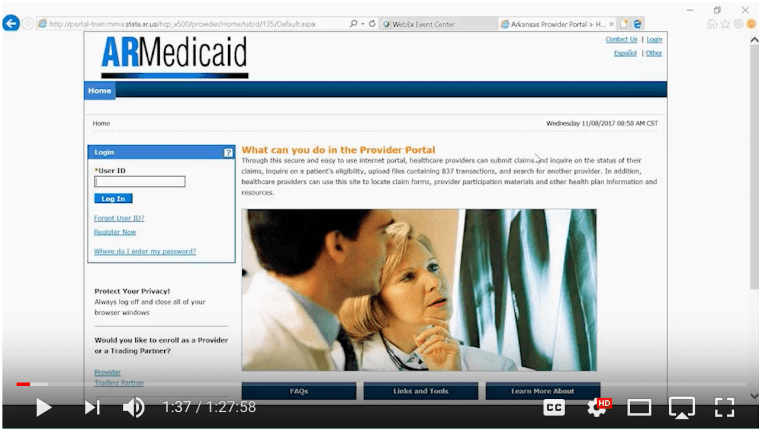
Here is a training webinar to help you:

Screen Shot 2017-11-15 at 8.24.12 AM


There is a list on their website that you can access.

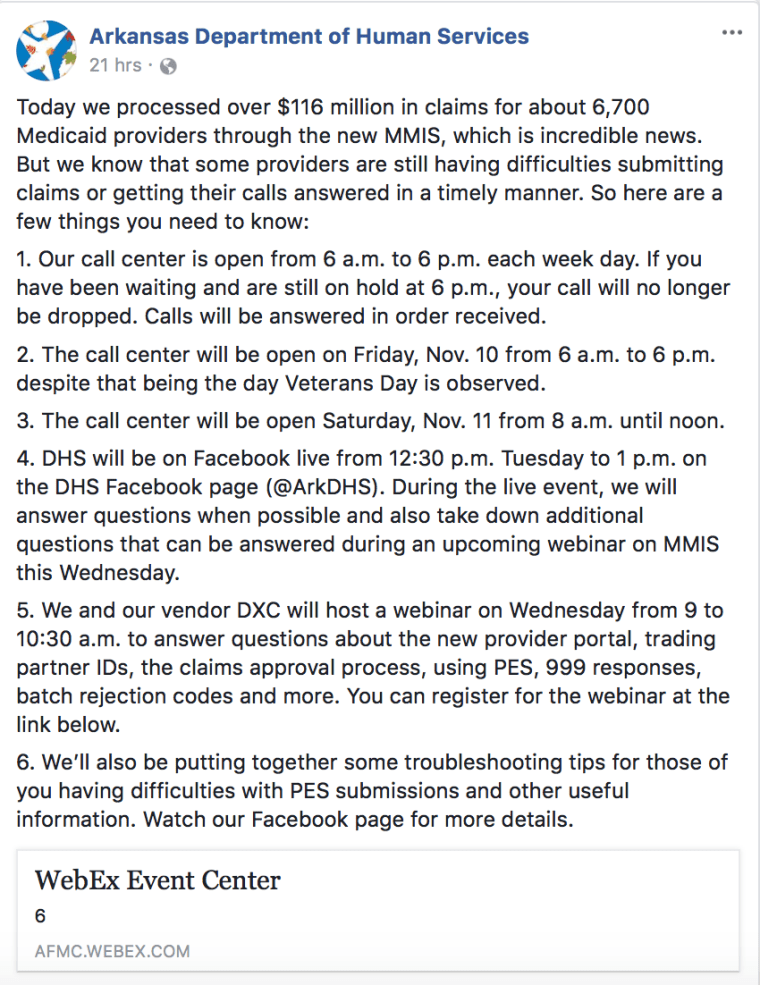
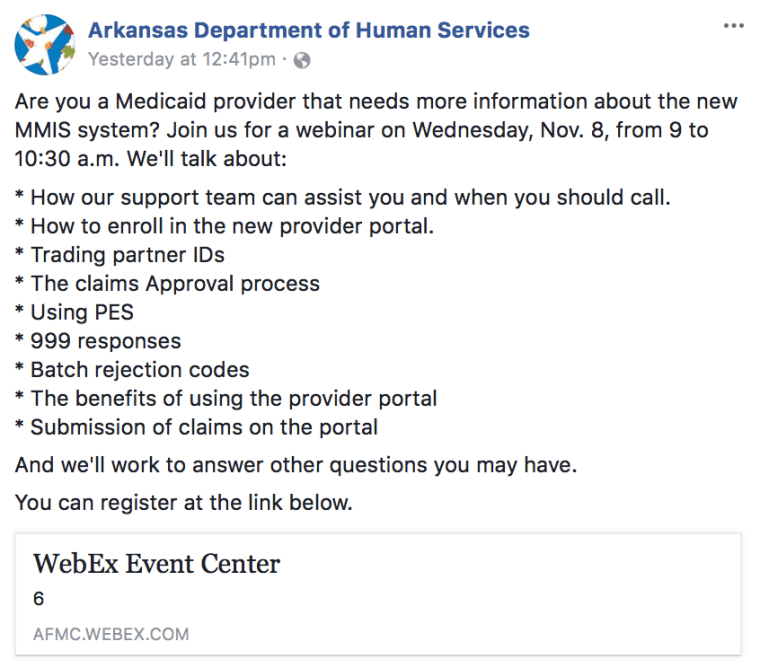
The following is a list of all the posts that they have done on Facebook collected in one place:

Screen Shot 2017-11-07 at 2.10.38 PM

Watch the Facebook Live in which a team of DHS staff and DXC staff attempted to answer questions live. Lainey with MSL collected provider questions and delivered them to the panel.

They weren’t able to answer questions in detail, and hopefully they will do that in the webinar on the morning of 11/8/17. If you can’t attend the webinar, they are recording it for you to be able to view later.
During the facebook live session, DHS shared the following links:

  • You can learn how to upgrade PES: HERE
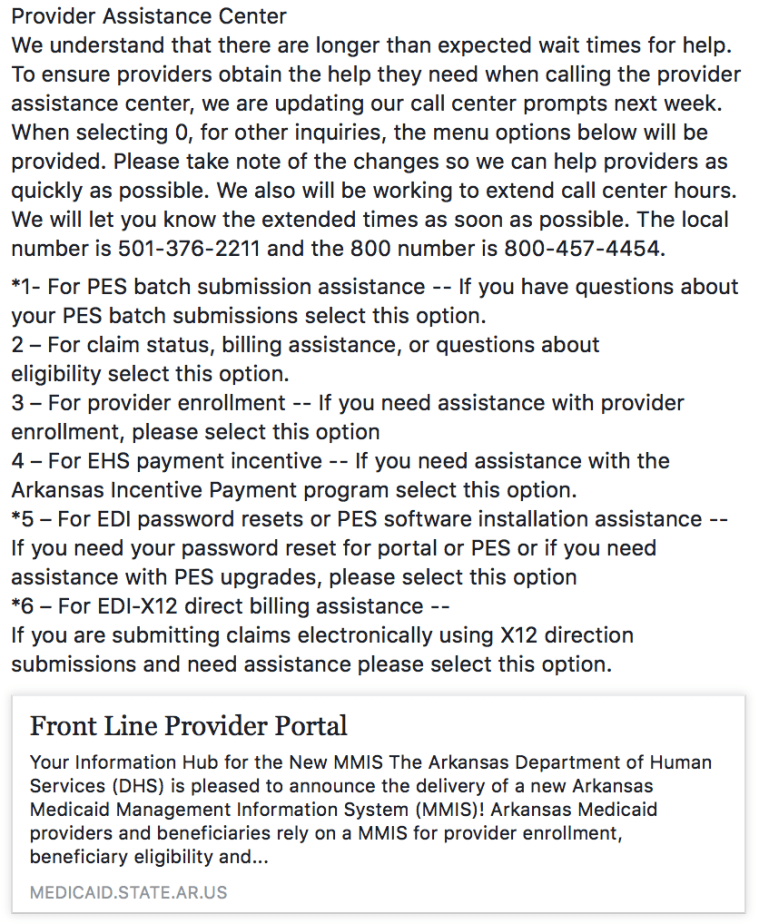
  • To reach out to us to address those common syntax error, call the local number is 501-376-2211 and the 800 number is 800-457-4454.
  • Need to know how to get a trading partner ID? Go HERE
  • Hub for MMIS news Click HERE.

Screen Shot 2017-11-07 at 3.10.32 PM

Screen Shot 2017-11-07 at 3.34.29 PM

Screen Shot 2017-11-07 at 3.37.36 PMScreen Shot 2017-11-07 at 3.37.49 PM

Understanding the House Tax Bill

Taxes affect our daily lives, and the House is working on a bill to “reform the tax code.” If taxes are drastically altered, it won’t just affect our personal taxes; Medicaid funding could be affected as well. For example, Senator Cotton called for the repeal of the Obamacare individual mandate through tax reform. That’s why it’s so important to stay on top of what’s happening.

A House committee released the bill, the “Tax Cuts and Jobs Act,” this afternoon, and it’s a very long read. 

This is just a first version. They will revise the bill and try to pass it through the House by Thanksgiving to send to the Senate in order for it to take affect by January 1, 2018. 

Take the time to try to understand it and respond if necessary. Here are a few articles to help you understand what’s going on:

Make sure you understand this for yourself, and contact your U.S. Senators with your questions, concerns, and comments!

    Updated PASSE Information

    Click the image below to receive comprehensive, updated information on the PASSE systems (as of October 2017). The deadlines have been updated, and if you were wondering what the purpose of the model is, here’s your chance to find out!

    Screen Shot 2017-10-31 at 9.36.43 AM

    Three PASSEs were officially certified on October 18: Arkansas Advanced Care, ARkansas Total Care and Empower Healthcare Solutions. Read more about them in the image below:

    Screen Shot 2017-10-31 at 10.20.51 AM

    Input Needed: INDEPENDENT ASSESSMENTS

    Next week, our Founder Lainey Morrow will be meeting with DDS Director Melissa Stone, BHS Director Paula Stone, and Optum (the company doing the Independent Assessments).

    They are going to answer our questions about Independent Assessments and explain the whole process. What questions would you like for Lainey to ask them?

    Also, they plan to provide training on the IA process, so you can know what to expect. They’ve asked for feedback on which method each one of you would prefer. This doesn’t mean they promise to provide it in that way, but they want your input.

    Use the form below to send your questions and input. If you don’t see an option that fits you, add your own.

    ← Back

    Thank you for your response. ✨


    Promulgation notice

    Heads up! All of the rules that just went through public comment are set to be promulgated next week. Which ones?

    • CHMS Medicaid Provider Manual
    • CHMS State Plan Amendments
    • DDTCS Medicaid Provider Manual
    • DDTCS State Plan Amendments
    • DDS Standards for Certification, Investigation, and Monitoring 
    • DDS Policy 1076 – Appeals 
    • Human Development Center (HDC) Admission and Discharge Rules Policy 1086 
    • Community and Employment Support (CES) 1915(c) Waiver
    • CES Provider Manual and Certification Standards for CES Providers 
    • The Provider-led Arkansas Shared Savings Entity Program – Phase I 
    • Independent Assessment Manual 
    • Outpatient Behavioral Health Services Update 1-17
    • Inpatient Psychiatric Services for Persons under Age 21 Update 1-17
    • Residential Community Reintegration Program Certification
    • Independent Assessment for Personal Care and Criminal Background Check Requirements for Providers 
    • Rules 117: Provider-Led Organization Licensure Standards 

    People with government and state agencies use that word, but what does it mean? “Promulgate means to formally proclaim or declare a new statutory or administrative law as in effect after it receives final approval. It means to make known, announce, or declare officially.” Source

    For these rules, the first step means they are going before a sub-committee to be discussed and possibly voted upon. The State ALC-ADMINISTRATIVE RULES & REGULATIONS committee on Tuesday, September 12 at 1pm. If you want to be present, check out the agenda and the location. So far this is the only time it’s shown on the agenda.

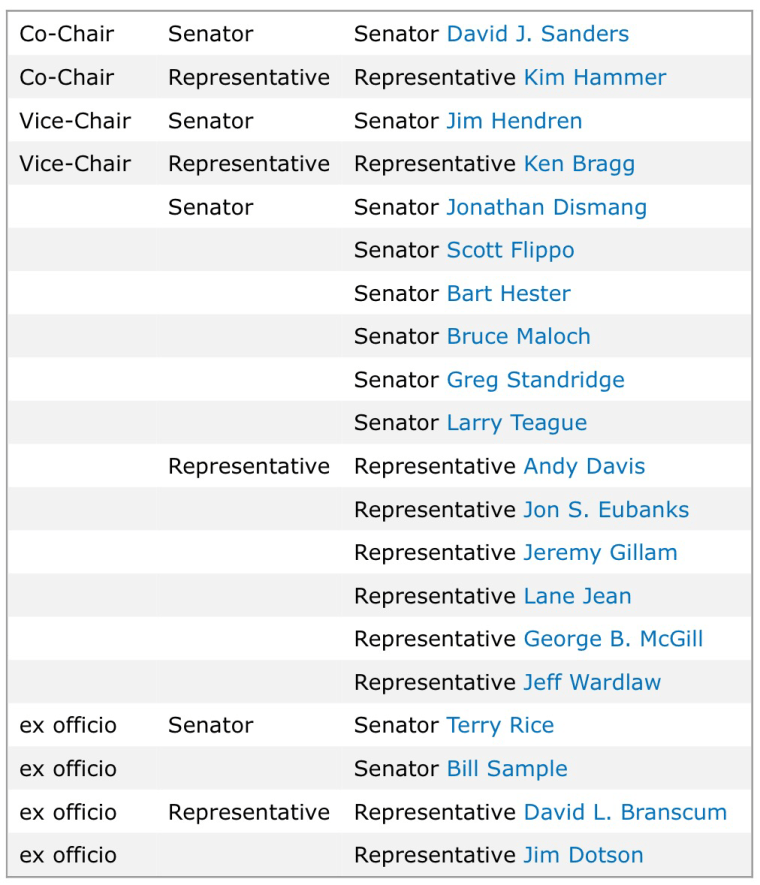
    According to the Arkansas State Legislature website, “this subcommittee reviews matters regarding administrative rules and regulations by state agencies, boards, and commissions as required by A.C.A. 10-3-309, and such other matters pertaining to administrative organization, rules, regulations, and procedures as may be assigned to the subcommittee by the Legislative Council.”

    Here are the members of the council:

    Therapy Cap PA Requests: Q & A 


    The PT, OT, and SH Association Presidents regularly meet with DHS and AFMC to discuss issues that providers have when requesting Prior Authorizations (PAs) for children who need therapy over the 90-minute cap. These are the results of their latest meeting.

    Keep track of your questions and email them to be discussed at the next meeting.


    The Recap of ArkSHA, ArPTA, and AROTA meeting with AFMC and DDS on 08-25-17:

    The following are issues raised by members of ArkSHA, ArPTA and AROTA, and responses from AFMC and DDS.

    Issue: Shifting of Units Between Therapist and Assistant

    There are still questions regarding the length of time it is taking to shift units from PT/OT/ST to PTA/COTA/SLPA and vice versa. AFMC reports that following completion of the large number of DMS-640 form validations AFMC received many change requests to prior authorizations. AFMC encouraged their staff to continue to process initial DMS-640 validations and that all changes would need to be checked before processing. Currently, AFMC states that they are about 10 days out on corrections and Jarrod McClain, AFMC Director for Clinical Review, indicated that their staff are working diligently to get the updates made as quickly as possible. The updates to the PA’s flow to DXC each night and providers can start billing immediately upon receipt of the changes.

    In addition, Jarrod stated that AFMC is working to decrease the timeframe for corrections but they have to ensure that they are getting the correct request ID modified. According to Jarrod, it takes a few days to check and update the claims data extract file. If providers continue to see a delay, please contact Jarrod McClain at AFMC. He will personally see that his staff checks on the status of their request and get it processed.

    Issue: Use of evaluations from preschool programs to kindergarten

    There was concern from many members as to how long their evaluations will be valid in a schools setting. The consensus is that if the evaluation utilized is an evaluation conducted by a non-educational agency, or by a provider who is not contracted by an educational agency, then the evaluation is good for one year. If an educational agency or a contractor of the educational agency conducted the evaluation, then the evaluation falls under the school-based evaluation criteria of every 3 years.

    Issue: Some prior authorizations were only approved after sending in a cover sheet restating information included in the evaluation.

    AFMC was aware of this issue and is working to improve their processes for approval. In the meantime, providers are encouraged to highlight justification for medical necessity in the evaluative reports, including statements about how the services recommended are under accepted standards of practice to treat the patient’s condition, how services are complex and will require the skilled services of a qualified therapist, and a statement about therapy prognosis (See Medicaid Manual Section II). Though a cover letter outlining these justifications is not required, providers are encouraged to consider using a cover letter attached to the evaluation to make these medical necessity statements more salient for reviewers.

    Issue: Are reviewers actually reading the evaluations or just looking for technical language?

    AFMC assured us that they are reading all evaluations. They perform both technical and administrative reviews in order to ensure that all requirements of the evaluative reports are included, as well as a medical necessity review to ensure that justification for medically based services is included.

    Issue: I heard that AFMC was using nurse reviewers and not experienced pediatric therapists in each discipline. Is this true?

    AFMC utilizes registered nurses to perform the initial reviews of all PA requests. If a request is denied than the request is assessed by an experienced licensed therapists specific to the discipline. If the therapist agrees with the denial it is then sent to a board certified pediatric physician for final review. If a provider does not agree with the denial or would like to request reconsideration they may do so by resubmitting the request.

    Issue: What about beneficiaries who receive services from multiple providers for the same service?

    AFMC and DDS continue to emphasize the need for care coordination for beneficiaries with multiple providers of the same modality (physical, occupational or speech therapy). Dr. Chad Rodgers, AFMC Medical Director, attended our meeting and reported that the pediatricians and PCPs he has been in contact with are interested in understanding what situations justify the appropriate signing off on multiple prescriptions. He asserts that although he can’t speak for all physicians he personally looks at every request for therapy services before signing them. He recognized that it is difficult to for most physicians to understand why a child needs multiple services. He and assistant director of DDS Elizabeth Pittman stated that it would be beneficial to state on the DMS-640 the specific need for a particular service and that the beneficiary will need the services of multiple therapists. AFMC and DDS are considering a change to the DMS-640 forms in the future to accommodate the different services provided within one discipline. Elizabeth Pittman reported that the new MMIS system (which has an anticipated implementation of summer of 2018) will be less burdensome on providers and will have the ability to disclose is the beneficiary is receiving services from other providers. Until then, providers need to ask during the intake process if the recipient is receiving therapy services from any other provider, and then coordinate as needed. According to Jarrod McClain, only 10 providers have bumped into challenges with the multiple provider issues thus far.

    Issue: For short term scripts (i.e. ortho docs who write for 2-6 weeks) that then need an extension once the patient has had a follow-up recheck. What is the most efficient way to keep PA’s from having to be unnecessarily done?

    Providers can simply go into Review Point, and click the extend button. The codes will be transferred over and the new prescription can be uploaded. Information about the progress of the patient and continued medical necessity should be included with the extension.

    Issue: It has come to the attention of AFMC and DDS that some facilities are sending notices to parents that they should not allow services for their child in the school due to the need for a PA if the school and independent facility are both treating the beneficiary.

    Although Medicaid is a “medical” assistance program, it recognizes the importance of school-based services. The federal Medicaid program actually encourages states to use funds from their Medicaid program to help pay for certain healthcare services that are delivered in the schools, providing that federal regulations are followed. The associations stand with AFMC and DDS that sending notices to parents regarding billing for services between schools and independent clinics is not recommended. IDEA laws require schools to provide services to beneficiaries if needed for educational purposes. Schools also must provide therapy that is medically necessary. Therapy services outside of the school setting should not replicate services provided by therapists contracted or working with the school.

    Issue: A representative at DHS has stated that physical therapy re-eval codes are no longer a valid code as of July 1st. Has anything changed in the recent rule change?

    Reevaluation codes are not currently and haven’t been a reimbursable code. The two billable codes for physical therapy services are 97001 and 97110.