
On Friday, DHS presented and explained this model of managed care to providers. In the days to come, I hope to get real, applicable answers for parents.
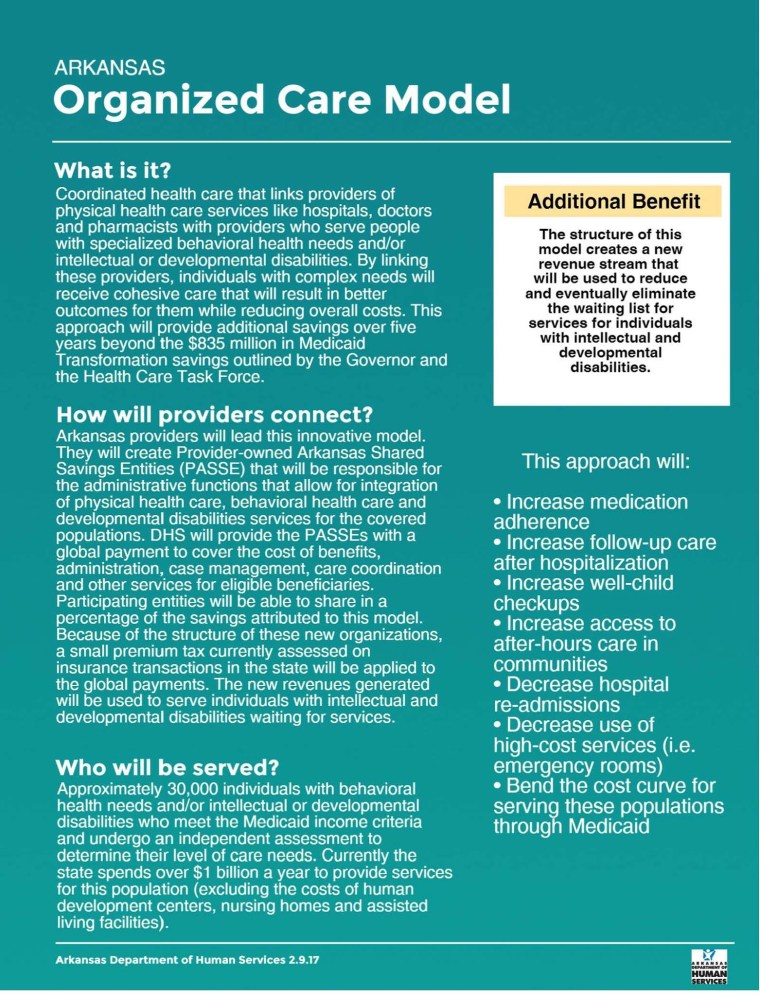
On Friday, DHS presented and explained this model of managed care to providers. In the days to come, I hope to get real, applicable answers for parents.
This data has been provided by the Stephen Group. They did this research when they recommended to Governor Hutchinson that Managed Care is a viable option for cost savings. This is being seriously considered by the legislature, and it is separate from the therapy cap that is passing through committees right now.
Before we know how to respond, we need to look at data on all sides of this issue. Please read this before you respond to your Representatives. But please know that these decisions are in work NOW. They have these facts that they believe support Managed Care. If you disagree, you will need facts as well. I hope to provide information against managed care as well to give a rounded view of the issue.
I have been given permission by the Stephen Group to share these files, and they have said that they welcome any of our questions.
2016-miliman-report-on-risk-based-managed-care
tsg-summary-of-managed-care-plans-survey-responses-for-task-force-9-2016
Author: Lainey Morrow, Founder of Medicaid Saves Lives
Direct quotations from Interview with Melissa Stone at her office on October 6, 2016
Forrest Steele, Assistant Director was also present.
I was again able to meet with Ms. Melissa Stone, Director of Disability Services (a Division of DHS), and she answered some more of your questions. Some questions required other people to answer, and I’m still waiting on that information. I invite you to comment on the answers given because Ms. Stone has agreed to meet with me again this week. I’d like to take some of your comments back to her.
Melissa: “It’s completely separate from this entire rule change. So I think we talked a little bit last time about transformation efforts within the special needs population, which would be Division of Developmental Disabilities, Behavioral Health, and Division of Aging and Adult Services. We are constructing a request for a proposal (RFP), which is the state vehicle to put a contract in place. There’s a lot that goes with a request for a proposal or request for qualifications (RFQ). You have to put out a document of kind of what you’re trying to buy, so that we can allow competitive bidders to bid on it. And there’s an entire process on how we rank them, and it’s very in depth, and it’s overseen by the Department of Finance and Administration. And that’s the only way we put contracts in place. Before we even put the contract in place, that particular RFP or RFQ is reviewed by the legislature. So we are in the beginning stages of… getting together the requirements for that vehicle, and we hope – it’s actually going to be run for us by the Department of Finance – and we hope that a draft version is out on our website next month so people can submit comments on that particular contract vehicle. So what we know for sure right now is back in 2008, the Center for Medicare and Medicaid, which we’ll refer to as CMS, passed a regulation that’s commonly referred to as Conflict Free Case Management. Conflict Free Case Management has essentially four elements, and what it says is if you pay for home and community based services under a waiver, which we operate a waiver here, because we have 4200 people on a waiver, if you pay through a waiver, [the Federal government is] going to mandate that you come into compliance, all states, with Conflict Free Case Management. One of the essential elements of Conflict Free Case Management is an independent, third party assessment. So that’s where this started. It’s a requirement. We are out of compliance. When I got into this seat, we had been operating on extensions. For various reasons, we had to get off of those extensions, and we’re having to come into compliance, and it’s been this long journey that we have been on with the providers who own and operate and run home and community based programs for clients on our waiver.”
Forrest: “And when that mentions conflict, does that talk about conflict of interest?”
Melissa: “Yes, thank you, Forrest. So we’re talking about the, it’s to eliminate any appearance or any actual conflict of interest. So not only do they say you need to do an independent third party assessment, you also need to have someone that does the client’s case management that’s in no way, shape, or form associated with the organization who provides direct day-to-day services. So this is a total shift on how we’ve been operating because up until, and even to this day, if you choose a provider, you can choose them to do your case management and your direct care. There we have a requirement they can’t be the same person but you can pick the same provider. So this has been like I said a journey to get providers on board with this idea, in agreement with how we’re going to move forward to comply with this regulation. We had several large stakeholder meetings with this group of individuals, these people who own and operate waiver programs, we have about 90 of them I would say, and they decided that they felt like contracting it out, and I agree with them, would be the cleanest, easiest way to comply with this regulation. So that’s how this process started for us. Those clients meet an eligibility criteria called Institutional Level of Care. It’s the same eligibility criteria that you have to meet to be a resident at an intermediate care facility. So the state of Arkansas, DDS, operates 5 intermediate care facilities, which are commonly referred to as human development centers. And then there’s private intermediate care facilities. The people on the waiver, and the people at the private and the human development centers are all deemed to be institutional level of care. Because of that reasoning, we are moving forward with doing independent assessments, the same independent assessment, on that entire eligibility population. So that is the only thing that is 100% for sure. And that’s what I’ve been talking about at stakeholder meetings and I’ve talked about over at the legislature. Those are the things we would like to move forward with for reasons of federal compliance. But as far as any other population of people with developmental disabilities or delays, we have not decided on that. And I know that a lot of the comments are wrapping these two together, and I understand why. I understand why they’re being wrapped together. Because it’s all being discussed at the same time. But I will say that for this rule, this rule is completely separate from anything going on with Independent Assessment.”
Lainey: “So there will be an opportunity to comment on this?”
Melissa: “We’ll put it up on the website, and we will actually send out notice. And it will be up there for 30 days.”
Melissa: “We have been working for a long time at the department to come up with ways that we can transform the services that we provide here across all divisions, not just across Medicaid divisions. So we, and I think Cindy Gillespie, the director, has really made vast improvements. She came in and did a shared service model, where we rather than having a group of people within each division who do contracts, and a group of people within each division who do finance, and a group of people who do human resource and hiring… she has designed a shared service model, which is just as simplistic as it sounds which is they are just floating out here to the left, each one of the divisions utilizes those offices for those functions, but every division is not silo’d in doing their own hiring, their own contracting, their own finance. And what it’s done for us so far, and it went into effect in July, and of course, we are still implementing because, you know, we have over 7,000 employees here. So you know, you’re turning a gigantic ship when you do a transformation like this. We have already seen the benefit of being able to start looking at bulk contracting to save money. So instead of DDS buying bread and Behavioral Health buying bread, we now are looking at, could we get bigger bang for our buck by putting in a bigger contract, negotiating it well, and getting a better price for all of us to get bread. And that is in the beginning stages, and we can already see a difference. And the same thing with finance. It’s not the DD budget versus the DCFS budget. Okay, let’s look at where your funding is coming from. How can we maximize federal dollars more appropriately across the department. So now that it’s a shared service model, there’s one financial officer division, he’s looking across the entire department to see what could we do differently to utilize our dollars better, and we’re already seeing that occurring. So there’s estimated savings with both of those shared services… we fully anticipate seeing savings from just operating our administrative functions differently like this.
I know that it feels very personal to OT, PT, and Speech, but we’re talking about a DDS transformation that we’re trying to accomplish to ensure better quality of care across all programs. The same thing is happening with Division of Aging Adult Services and with Behavioral Health because those three divisions are the highest spending in Medicaid. It’s the fewest amount of people, but it’s the highest dollar amount. And you would expect that. Those are people who need services, those populations, but we are looking at ways that we can be more efficient with those 3 populations.”
Melissa: “I think it’s premature to make that kind of correlation. Of course, we’re hoping this passes, but I would not make that correlation. And I wouldn’t want to assume anything.
Lainey: “So what do you say to people who are afraid of that?”
Melissa: “Managed care has been on the table for some time now. We actually were under managed care several years ago for a period of time. I think it’s just a reaction or a possible remedy to what we’re facing right now when it comes to Medicaid sustainability. We are trying to put transformation efforts in place that will help sustain Medicaid, and this [proposal] is one of them. But managed care is also an option that’s being discussed that would help sustain the program.”
Forrest: “I think at this point, people who are having these discussions aren’t really eliminating anything as a potential option that’s so important. Keeping the options open as we move forward.”
Melissa: “I would say that the modification that is coming that is being discussed that we just went over is the Independent Assessment process. And like I said, the only 2 programs that we have definitively come out and said we would like to pursue in terms of Independent Assessment are the clients that are on the waiver and the ones entering intermediate care facilities. I wouldn’t say that one area is more concerning than the other. I mean, we are literally looking at every program within DDS to see how we can make it more efficient. But we have been doing that for over, I mean literally, since maybe the past 2 years that I’ve been really involved with it. And I’ll tell you, based on looking at those areas, we’ve put processes in place in our human development centers, we’ve moved to this shared service model, we’re looking at the therapy thresholds and the Independent Assessments right now with those 2 populations.”
Melissa: “There is no proposed plan to reduce the TEFRA premium at this time.”
Melissa: “I just want to reiterate that the PA process, like I said the provider workgroup is putting together specs. We’re not trying to make this as difficult as possible. I don’t anticipate there being that kind of paperwork to turn in that would require hiring additional staff to handle it.”
Lainey: “Well, this person said that they were told that all of the kids would have to be seen at the cap that is being set even when they need more because they won’t have enough staff.”
Melissa: “Well, I hope a therapist didn’t say that because if a child needs more, and is deemed to need more under evaluation, I would hope that they would turn the paperwork in to get a child more.”
Melissa: “So this is a provider that clearly does business with Medicaid frequently. This is a practice that we have in place for other programs. We don’t have the specs back, but I’m going to log that in as a comment.”
Lainey: “That’s the way that it worked with our daughter while we were waiting for TEFRA. Is that how this will work because it already works that way in a lot of cases?”
Melissa: “Well, it’s a very good suggestion.”
Forrest: “And it does sort of fit the norm.”
Melissa: “And it does fit kind of what we do in other programs.”
Lainey: “It does, I just think the concern would be staffing. Can they sustain – it just depends on the turn around time with the proposal, which you’re going to write in is really a short time like you intend, then it wouldn’t be that long. But with the TEFRA approval it’s 2-3 months, and her provider was treating her and paying their people out of their own budget until they get that money back. Three months is a long time to hold that.”
Melissa: “There will be no carve out for certain providers or certain clinics. Anything that is implemented will be across the board for a program, not a private company.”
Lainey: “Do you think they meant PA? Because from your description, Independent Assessment doesn’t…”
Melissa: “I think there’s fear out there about Independent Assessments. They have been discussed. They have been mentioned by the Stephens group. They have been discussed. Their initial recommendation was for Independent Assessments across Medicaid programs, so there’s been talk of this Independent Assessment that’s concerned providers for months. So it’s unclear to me whether or not they’re talking about PA process or Independent Assessment.”
Lainey: “Yeah, the terminology is hard to get…”
Melissa: “But regardless, it’s the same answer because anything implemented by DHS will be for a program, and there won’t be special exceptions for a private entity.”
Melissa: “So the provider workgroup, that is made up of these clinicians OT, PT, and Speech, have said from the very beginning, and I fully agree, that whoever is brought on board to review Prior Authorization paperwork, they will need to be qualified, and they will need to be clinicians. But here again, these are specs that would be in that [RFP] or [RFQ] document that we have not begun drafting that I anticipate will be out for a draft for public comment in the spring. And these are things that we can put into that, we can put requirements in there of what kind of credentials the people would possess as well as the turn-around time. And all of those specifics.”
Melissa: “So within Medicaid, we have a medical necessity definition for everything that Medicaid does, and Medicaid is made up of doctors, clinicians, nurses who are very familiar with this process of sometimes 2 doctors do not agree. Sometimes our Medicaid doctors and an outside doctor do not agree. That’s why there’s always a very clear appeal process in place. There will be such an appeal process in place for this.”
Lainey: “So when they disagree, do they contact the doctor? Or do they just deny it?”
Melissa: “Whoever they’re not agreeing with is notified of course because they have a right to appeal. And so they are given paperwork that shows how they go through that process.”
Melissa: “Qualified recipients who need therapy will be allowed therapy.”
Lainey: “Basically, I guess she’s saying if nothing is changing, then there would be no cost savings.”
Melissa: “We anticipate cost savings.”
Lainey: “That sounds scary. My daughter [because of her diagnosis] in most cases gets the max… but not everyone’s kid is that kid. There are people who are [worried], namely people whose children don’t have a diagnosis.”
Melissa: “And I feel that from the comments, it’s mostly the kids that are just like my own.”
Lainey: “Is it okay [for me to share] that?”
Melissa: “Yeah. We went to the Dennis Development Center, and they can’t pinpoint exactly why he’s delayed, but he gets OT and Speech. And those are the cases that are scaring the families. But I have no doubt in my mind that the therapists who see him during their evaluation, which a standard, nationally-used speech and OT evaluation is what they used on him, that those evaluations wouldn’t speak for themselves. And they do if I’m trying to receive Prior Authorizations through my insurance. The therapists that have come to me that aren’t concerned, such as Access Schools who sent out an email to their families, they feel like they can justify the need. They’re professionals, they stand behind the minutes they’ve been prescribing, and they’re confident that their children won’t receive disruption.”
Melissa: “We are getting that comment, and we’re looking at that.”
Lainey: “So you might consider that? Would that start this whole thing over?”
Melissa: “Yes. We are looking at that as well.”
Lainey: “I think that would satisfy some people to know that you’re at least considering 120.”
Melissa: “Absolutely, we’re considering every comment… we’re going to spend time based on the comments looking at the data to see what’s appropriate – if we need to come off the 90 minutes and how we need to react to the public comment based on the data.”
Melissa: “This is showing a lot of reasons why the federal government and that would trickle down to why the state is looking to put some quality control metrics in place when you see that there’s that many millions of dollars that were administrative or process error, and you go down and only one million of improper payments was due to not medically necessary. It’s showing that it’s not that they’re denying it because it’s not medically necessary. They’re denying claims because of these other reasons, and the dollar amounts are actually astounding. In my mind, that supports the idea that quality control is needed and could be very useful.”
Lainey: “So what do you say to their point that the smallest number is not medical necessity, which is their view of why we’re doing PAs?”
Melissa: “Well, we’ve never come out and said that medical necessity is the reason we’re doing PAs. We’ve consistently messaged that we’re doing this as a quality control. The reasons that are laid out in this question show the need for quality control, and it doesn’t show that it’s because we are going to deny therapy that’s medically necessary to save money.
Melissa: “We need to talk about this with the Medicaid person. That’s definitely worth looking at.”
Melissa: “So the Medicaid Integrity Unit is run by a man named John Park, who they do investigate allegations of waste, fraud, and abuse. He would not be involved with programmatic changes such as this.”
Author: Lainey Morrow,
Direct quotations from Interview with Melissa Stone at her office on October 6, 2016
Today, I was able to meet with Ms. Melissa Stone, Director of Disability Services (a Division of DHS). I gave her some comments from our group; she received your stories of your loved ones and how much they need this therapy. She said DDS intends to respond to all of your comments. I also took our questions, and I was able to get some explanation from Ms. Stone. We all seem to have similar questions, so hopefully this will help you. If nothing else, you may learn what some of the acronyms mean! It was a lengthy conversation, but it’s worth a read. I invite you to comment on the answers given because Ms. Stone has agreed to meet with me again next week. I’d like to take some of your comments back to her.
Melissa: “This was brought to the division from a workgroup that was made of up representatives from the ARPTA ( Physical Therapy Association), AROTA (Arkansas Occupational Therapy Association), the CHMS (Child Health Management Services), DDTCS (Developmental Day Treatment Clinics), DDPA (a group of providers that provide waiver services), and Early Intervention Providers that provide services through our part C Federal grant. They have been meeting frequently to look at areas within DDS that are lacking in quality control devices, and this was brought to me as an idea of inserting a 90 minute threshold as a way to insert some quality control.”
I don’t have a quote on the context, but I’ll try to paraphrase Ms. Stone:
Cost savings in DHS is happening across the board with the elderly, mental health division, and the therapy services. The Stevens Group was hired to provide a report of many ways that the costs savings could be achieved. The division on aging came up with some internal quality controls to implement without having to involve the public, and the mental health division will see an improved plan next July. The Disability Services sector has proved to be more complicated, but this proposal is an attempt to work with professionals in all therapy fields (otherwise known as the workgroup) to come with realistic cost savings.
Melissa: “That word is going around a lot – the “cut” or “reduce” budget. When Cindy Gillespie got here as the DHS Director, that has not been her focus. Her focus has been about getting good quality services at the right time for the right people and doing more outcome measurements to ensure that what we’re providing works and getting people on services and back on their feet. And I know that doesn’t work specifically for my particular group of clients, the developmental disabled or delayed, but it does on a broader spectrum across DHS services. That has been where she has been trying to shift the focus since she got here. I think we do truly believe that if we offer efficient, early prevention services, that it will actually save us money in the long run. And that’s what we’re trying to focus on, but we also know that we’ve been operating without quality controls in place. This is an example of that – that right now we have a contract in place with AFMC that is a look-back at therapy, and if you look at the contract it’s a 3 month look-back. And what they are looking at is if a prescription is in a file, and if the therapy is in adherence for the past 3 months with that prescription. This 90 minute threshold per discipline per week is a way to better ensure that the prescriptions are being utilized correctly across the board.”
Melissa: “Public comment ends on October 14 at midnight, and we will take all of the comments, and we’ll group them because a lot of them are kind of similar. And then we’ll give formalized written responses to them, and we’ll put that up on the website. And people have been asking if we’ll directly send them a copy. I don’t think we’ll directly send a copy, but what I’m going to ask is from those sign-in sheets from last night. I’m going to make an email file like a group, and we’ll send out a notice that says they’re up on this website, and this is the link, and this is how you pull them down.”
Lainey: “So that is the response to the Public Comment. Then what?”
Melissa: “Then the way that the state of Arkansas probligation process works is that we go before the legislative committee of public health, which I don’t know if you know this, but Senator Cecille Bledsoe, who was the very attractive woman on the front row, is the chairman of public health. So I was glad that she was there sitting on the front row yesterday. So she and her committee will review the rule. And then there’s a second committee that actually has to review, vote, and pass the rule after that. And that will happen, and I think we’re trying to meet at the very end of October for public health, and then in November, if it’s on track, it will go before that (legislative) committee. Once it does that, because it’s a state plan, it will be a state plan amendment. We actually have to send it to the federal government for the last approval. And they say yay or nay. But I’ll tell you, you’re in the public comment period, and I meant this when I said this yesterday, we’ll look at all of this, and if there’s a substantial change to what we’ve put out the notice of rule makings – if there’s a substantial change to the 90 minutes per discipline per week and say we do something different, it almost stops the clock and starts back over, and then we’ll go through it again. So it could be a long process.”
Lainey: “So some of these questions are hard to answer because you haven’t come to that part in the process. The thing that would concern me is that this (working) group would – like we’re having public comment now – but what about when you’ve kind of come to more decisions? You know, for example, what if you all come to the decision that the return time on an authorization would be a month? What if the public didn’t like it? What’s their option?”
Melissa: “So there’s a lot of options. So say this rule passes, and everything is ready to go on this. It’s on the books and ready to go July 1. There’s still a whole other process of putting a contractor in place to do the PA (prior authorization) process. That process is just like this process. You have to put the RFP out for public comment, you ask for bids, people bid on it, it goes over to the legislature, the legislature hears about it, reviews it, and has to vote on it. So this whole thing with the PA process will go through almost an identical process on its own next spring.”
Lainey: “And that’s when you’ll determine the time?”
Melissa: “Yes. It’ll be all laid out in the contract. And the legislature votes on our contracts. So we do a lot of checks and balances with them. We really do. I don’t think the general public realizes how much say their state rep and state senator have over how we operate.
Other DDS Representative present: “Yeah, in the RFP, they would put in the required timeframe, and the vendor would have to turn around within, and that would be a performance measure in their contract.”
Lainey: “And if they can’t do it then?”
Melissa: “Then we would usually withhold money or cancel or…”
DDS Rep: “We would have the right to financially punish them or cancel.”
Lainey: “So this question is what tools will these individuals be using to determine that this person is qualified to do that? That would be during this process?”
Melissa: “All of the qualifications will be laid out in the contract.”
Lainey: “So this working group would help to determine the qualifications? And they’re all qualified people themselves, so?”
Melissa: “Right. They’re all clinicians.”
Melissa: “Well it was eliminated for the contract that made reference to the AFMC retrospective 3-month look-back. And it was eliminated because there were problems with it. And I think rather than, and I wasn’t here at that time, but rather than fixing those problems, they just went a different route. A lot of the people, a lot of the women, who are on this work group were here when that PA process was in place. In fact, one of the men on that group said, ‘I have that whole PA process on floppy disc drives.’ And we all kind of laughed like, ‘Well, how are we going to get it off?’ And someone said, ‘No, I’ve had them all burned to a disc.’ And I said, ‘Oh, thank goodness.’ So they said we can tell you what worked and what didn’t work. We remember. We were here. And so that group is pulling out that disc, and going through it, and they’re presenting that as part of their proposal when they hand that to us.”
Marcie Lyn Johnson posted several questions in our Facebook group:
Melissa: “So nothing is going to change in terms of how it currently works. I think we use something called the, and this is a Medicaid form, the DMS640 form, and we have not made any changes to that. So if you look at the manuals that have changed, it said that you are allowed 4 units of OT, 4 units of Speech, 4 units of PT per day. That has really been striked through, and now it says 6 units of each per week. Nothing else about how this process worked is changed. So when you hit this 6 units per week, if you need more than that, then it’ll be a prior authorization. And that is the process that this clinical team that I mentioned, the work group, is working on the specs that will be utilized for the third party outside contractor that will do that. We have outside contractors that do that right now for other Medicaid state plan services. So this PA process is not a new concept. It’s used by a lot of states, and it’s used by our own state in other aspects. But we are committed to making people feel a little bit more comfortable with this. And the workgroup has said that we really would like clinicians looking at this paperwork, and we agree. If you have people saying whether or not something meets medical necessity on a document in review, they need to be qualified to make that determination.
[See previous process and contract implementation discussion above.]
[See previous process discussion for context to the following statements.]
Lainey: “At this point in the process, you haven’t determined that. When would that be?”
Melissa: “The contract leg of that. And that’s kind of in here. It’s very similar to what we already do for PA process for other therapies.”
Lainey: “But it’s a whole other, the public will get to comment of that particular?”
Melissa: “The contract. Yes.”
Melissa: “So in the public notice that ran in the newspaper, we were legally required to put a savings amount. So there’s a number in the newspaper article of what we estimate this would save the state of Arkansas to implement the process. That was the public notice.”
Lainey, reading: “It says, ‘total estimated annual savings $56,235,645.'”
Melissa: “That was the estimation at the time from our Chief Financial Office here at DHS.”
Lainey: “So that is simply by eliminating people who shouldn’t be referring a kid to a center that they don’t really need to go to. That is all that will save this money. (I was referring to abuse that was mentioned at the public meeting.)”
Melissa: “I don’t really want to, I just don’t feel qualified to speak to how they came up with the data on this money. I mean that is some of the stuff that we’ve talked about, but this was projections of the savings that would accrue by inserting a 90 minute threshold and taking an account a percentage of approved PAs based on the current use.”
Melissa: “They’re asking me what the Governor means… on a statement I’m not sure he said. I’m going to pass on that one.”
Lainey: “Umm. I can understand that.”
Melissa: “Managed care was a hot topic in the past. It was recommended by the Stevens group. It was a way for them to achieve the savings. It was voted on in the legislature, and it failed. During a special session. The 2017 legislation starts in January, so there’s speculation that managed care will come up again. And that’s probably where that’s coming from.”
Lainey: … “So this was in the Stephens report, and that’s probably where this discussion came from… but right now that’s not necessarily what you’re discussing.”
Melissa: “I think the provider networks, some of them are worried that if they don’t help us come up with a cost saving ideas, that that would be a next step. I think that is spreading amongst the provider network from things I’ve been hearing.”
Lainey: “But there is that question. If you can’t cut enough money, what happens?”
Melissa: “We are coming up with best practices that hopefully also will save taxpayer dollars the best we can without interrupting needed services.
Melissa: “I wouldn’t say ‘abusing the system.’ I would say that we really modeled this after what a lot of other states are doing. We looked at other state plans. We’re in the minority of not having a quality control mechanism in place when it comes to therapy. So for example, Alaska, which they actually do really good work in the DD arena is what I’m hearing. They’re using a prescreening tool that was highly recommended to us by CMS, but Alaska for PT, OT, for children with development disabilities under the age of 21, is only allowed through medical necessity and a prior authorization. There’s other models that are completely 100% of PT, OT, Speech are prior authorized, and there was suggestions, and there’s been a lot of talk about that we should really model some of the Medicaid services just like what state employee insurance provides. And state employee insurance provides 12 sessions a year, and everything else gets prior authorized. So there was a lot of discussion of things, and I felt like the 90 minutes was a good balance. It brought the quality devices that we were looking for, but it wasn’t too restrictive. And if we can do the PA process as quickly as we are hoping, there should not be detrimental effect.”
Melissa: “No. Just based on feedback we’ve received, and standard practice nationally, we think it would be beneficial to insert an ‘ages and stages’ screening. It’s used a lot by Pediatricians already in our state. It’s another tool that can help pediatricians recognize developmental delays in referring children for services.”
Melissa: “Yes. TEFRA is Medicaid. It’s just you privately pay into it.”
Melissa: “I don’t know the specifics right now. [See process of the law above.] I am hopeful based on the clinicians we have putting together the process that it will not be a burden on people.”
Lainey: “It sounds like the parents aren’t necessarily having to do anything, it’s the…”
Melissa: “No, so PCPs and physicians that bill private insurance are very familiar with this. They do that every day to get children that are on private insurance therapy above their 12 sessions a year. That’s very standard. So it’ll be pediatricians and therapists who are also familiar with that process who run businesses making those requests.”
Lainey: “Somebody that I talked to today called this an administrative nightmare. So it’s not going to be as bad as they’re thinking paperwork-wise?”
Melissa: “We have to remember, this is going to be a third party vendor. I’m not talking about DHS employees reviewing PAs. We’re going to have them under a very tightly written contract with performance measures. If they don’t meet them, there will be contractual implications such as withholding their money up to cancellation.”
Lainey: “So how long will it take for you to make that decision that they’re not performing well?”
Melissa: “So lucky for us, the general assembly inserted a lot more contracting parameters, so we do these things called vendor performance reports every three months on every single one of our vendors. So every contract we have in place, we evaluate them every three months.”
Lainey: “So this is all on the therapists. If they need more therapy, there’s going to be a pretty clear process in place, once you get to that stage, on how to get the kid more therapy?”
Melissa: “Yes.”
Lainey: “But (as previously discussed) you can’t talk about right now how much time that will take. Is it correct that the 90 minute, or therapy beginning will not be delayed? People are very concerned about the time turn around.”
Melissa: “Oh the timeframe will be in there (the contract).”
Melissa: “We’re not changing anything regarding evaluations.”
Melissa: “It will be your same therapist doing the comprehensive evaluations if that’s what your child gets.”
Lainey: “And then the third party, you all will determine…”
Melissa: “the credentials for those people and the turn-around time for when they have to respond.”
Lainey: “And that’s a sticking point where are people are afraid that these people are going to say No because they don’t know the kid, whereas these therapists are with them personally.”
Melissa: “The therapist is writing the documentation that will be turned in. It’s a document review. So it’ll depend on the documentation submitted by the therapist. And I’ll just say, the ones that do private insurance billing, if the child qualifies, the child qualifies. If it’s not written correctly in the evaluation, and they get denied for some reason, there will be an appeal process, and we’ll be able to correct it. So it’s going to depend on how that therapist writes up the documentation that’s being turned in for review. But I have faith that these professionals know how to do that.”
Lainey: “So the appeals process will be also be written in to the turn-around time?”
Melissa: “Yes.”
So if you’ve made it this far, then you’re ready to get some more comments in before the Public comment period ends on October 14. Your comments are helping! Please send them.
 Medicaid Saves Lives